Showing posts with label England. Show all posts

Friday, August 30, 2013

LADY AUDLEY'S SECRET by M.E. Braddon

When I joined The Classics Club, the first thing I did was go through the list on Kindle, to see which of the books were available for free or reduced fees. This is one of the great things about reading classics—many of those in the public domain are available at no cost for e-readers through the volunteers at Project Gutenberg. I figured I would load a couple of Kindle titles immediately so I didn’t waste any late night reading time, which is when I really enjoy using my Kindle. And one of the first items I loaded was M.E. Braddon’s Lady Audley’s Secret. Lucky for me, a night of insomnia led me to yet another unexpectedly enjoyable classic!

Lady Audley’s Secret is often described as the quintessential Victorian “sensation” novel, providing a glimpse into that tightly ordered world by examining what happens when its conventions are completely abandoned. The novel begins with the poor but beautiful Lucy Graham winning the heart of widower Lord Michael Audley. Formerly employed by the local doctor as a governess, Lucy’s life before coming to Essex is veiled in some sad mystery. Lord Audley adores spoiling his young and charming wife, hoping to make up for her past unhappiness, to the disgust of his own daughter Alicia (who happens to be about the same age as her new stepmother).

Meanwhile, back in London, presumptive heir to Lord Audley’s title barrister Robert Audley runs into a dear old friend, George Talboys, just richly returned from a gold-panning expedition to Australia, who is searching for the young and beautiful wife he abandoned in an attempt to change their dwindling fortunes. The fortunes were dwindling, I might add, because George’s father disinherited his son when he rashly chose to marry the beautiful but penniless Helen. Alas, just as George triumphantly returns to England, her death is announced in the papers, breaking his heart. But fate brings the many threads of the story together at Audley Court – until, of course, George Talboys mysteriously vanishes, and Robert is compelled to find out the meaning of his friend’s disappearance – no matter the cost to his beloved family.

I like to think of it as the Grandmother of every radio serial and soap opera ever produced –many of the motifs that pack this 300 page novel are still playing out on the airwaves and Internet today: revenge, doppelgangers, orphaned children, unscrupulous parents. I read that it was originally printed in installments, which explains why each chapter adds some information about Lucy’s past – and ends in some kind of cliffhanger. Reading it all together makes for quite a rollercoaster. The seven deadly sins get quite a workout in Lady Audley’s Secret, but as you’d expect from a Victorian novel, the heavenly virtues are also in evidence, drawing a very clear delineation of those who live within society’s boundaries, and those who live without. There’s also a healthy dose of the occult. For example, Alicia’s dog seems to have a preternatural fear of the new Lady Audley:

The Newfoundland rolled his eyes slowly round in the direction of the speaker, as if he understood every word that had been said. Lady Audley happened to enter the room at this very moment, and the animal cowered down by the side of his mistress with a suppressed grow. There was something in the manner of the dog which was, if anything, more indicative of terror than of fury; incredible as it appears that Caesar should be frightened by so fragile a creature as Lucy Audley.p. 72

I thoroughly enjoyed every frothy, overwrought minute of this novel. It was so true to its time period, yet edgy in its confrontation of social taboos. I had never even heard of Lady Audley’s Secret until, trying to expand beyond Elizabeth Gaskill, I looked up a list of female Victorian authors and found Mary Elizabeth (M.E.) Braddon. The book also appeared on the Manchester Guardian’s 1000 Books Everyone Must Read: The Definitive List. That’s a pretty bold claim for any list, and I certainly found some striking omissions (not surprisingly, the list is very English-centric), but I think it’s a fabulous resource, conveniently broken up into genre: comedy, crime, family and self, love, science fiction and fantasy, state of the nation, and war and travel. I will definitely be culling this list for more ideas for future challenges, as the recommendations so far have been outstanding.

This book counts as my 19th Century Classic for the Back to the Classics Challenge, hosted by Sarah Reads Too Much, and is my second book for The Classics Club. It was free for my Kindle, which keeps my total for that Challenge so far at $2.51. Since this is considered a crime genre classic, I am also linking it to the R.I.P. VIII Challenge, hosted by Carl V. of Stainless Steel Droppings, which started just a little bit early this year.

Saturday, August 3, 2013

NIGELLA EXPRESS by Nigella Lawson

I had never seen Nigella Lawson on television until I went to England and Wales this summer. Exhausted from a conference – oh, and from running around London with a tween looking for Harry Potter filming locations – we were thrilled we could “veg out” in the evening with the Food Network UK. (Ah, the comfort. Ah, the bacon!) Our schedule (and jet lag) introduced us to two new-to-us shows: Nigella Kitchen and Bitchin’ Kitchen. Back home, I looked for accompanying cookbooks because my daughter had enjoyed the shows so much, and Nigella Express was the first one I saw. Which is why Nigella has the (dubious) distinction of being my first Rent Before Buying review.

Who is Nigella Lawson? Self-proclaimed “Domestic Goddess,” daughter of a former Chancellor of the Exchequer of Great Britain, and until this week the wife of the advertising-made bazillionaire Charles Saatchi. She is a self-taught cook, and her curvaceous appearance and flirtatious delivery helped to define what media critics refer to a “food porn.” Lawson is an icon in the UK, with a string of successful cookbooks and cooking series to her credit.

Take on Cooking: Nigella Express is Lawson’s ode to the busy working mom – someone she knows more than a little bit about, what with running a media empire and being a mother of three! It’s all about giving yourself a break and getting good tasting food on the table fast.

The Delicious Parts: The book is beautifully photographed, and Lawson’s personal stories make it an entertaining read. She comes across as down-to-earth but just a little bit edgy– kind of like the Anti-Martha Stewart. And Lawson has a real talent for putting together flavors that work well together. There’s plenty of spices and seasonings, with some unexpected combinations.

Not Quite To My Taste: The “express” part of the title comes with some shortcuts that we don’t usually use, including a lot of processed products –mixing jarred spaghetti sauce, broth and pasta for minestrone seems a bit too express, if you get my drift. Also, the “comfort food” aspect of the book meant that a lot of the recipes were very fatty. So I wound up adding steps and substituting ingredients to make meals for my family. The book is dessert heavy, because sweets are definitely Lawson’s thing – but we aren’t habitual dessert eaters, so a lot of the recipes would go unused (although I’m pretty sure my daughter would be happy if I used them).

Recommedation? Devour, Split, Send it Back to the Kitchen? For me, it’s a definite split—it’s going back to the library, and I don’t have to purchase it. But I can see why others would devour it, especially dessert lovers, and those looking for one cookbook with a broad set of recipes! I could see this as a great shower gift or new parent gift – perfect for someone not used to getting a meal together every night.

One Great Recipe: Nigella Lawson’s Curry in a Hurry

2 T. canola or other oil

3 T. finely chopped scallions

3-4 T. green Thai curry paste

2 ¼ lbs. chicken thigh fillets, cut into strips about 1 ½ inches by ¾ inch (I used considerably less, only about a pound, and for the four of us the proportions were fine)

1 14-oz can coconut milk

1 cup boiling water + enough chicken bouillon or concentrate to make 2 cups (I used veggie broth)

1 T. fish sauce

1 ½ cup frozen peas

1 ½ cup frozen edamame

1 ½ cup frozen slender beans (I used fresh because they are in season)

3 T. fresh cilantro

Cooked rice or noodles (I served this with a spicy chili rice)

Lime wedges

1) Heat the oil in a large saucepan, on that owns a lid, and drop in the scallions. Cook, stirring for a minute of two, and then add the curry paste.

2) Add the chicken pieces and keep turning over heat for 2 minutes before adding the coconut milk, stock, and fish sauce, and then the frozen peas and soybeans.

3) Simmer for 10 minutes, then add the frozen green beans and cook for 3-5 minutes.

4) Serve with rice or noodles, as wished, sprinkling over the cilantro as you do so. Put a plate of lime wedges for people to squeeze over as they eat.

Weekend Cooking is open to anyone who has any kind of food-related post to share: Book (novel, nonfiction) reviews, cookbook reviews, movie reviews, recipes, random thoughts, gadgets, fabulous quotations, photographs. If your post is even vaguely foodie, feel free to grab the button and link up anytime over the weekend. Please link to your specific post, not your blog's home page. Thanks to Beth Fish Reads for hosting!

FTC disclosure: I did not receive a free copy of this book for review.

Tuesday, July 23, 2013

COLD COMFORT FARM by Stella Gibbons

One of the things about being generally regarded by your friends and family as “well read” is this: you are subject to stares of utter disbelief when you admit to not having read a book that someone else consider “classic.” “YOU haven’t read Kafka on the Shore? I can’t believe it! You went on and on about The Belly of Paris last month, and you haven’t even read Murakami? Even my Cousin Waldo the Luddite has read THAT one!”

It’s kind of hard not to take it personally.

One of the books that I routinely got berated for not reading was Stella Gibbons’ Cold Comfort Farm. English friends in particular could not believe this galling oversight in my reading biography. So needing a 20th Century classic for the Back to the Classics 2013 Challenge over at Sarah Reads Too Much, I decided to see what all the fuss was about.

Finally, I realize why everyone was amazed that I’d waited so long to read this book. There aren’t too many novels I’ve found as absurdly funny as Cold Comfort Farm. And believe me, that’s saying something. Because absurdly funny is one of my favorite things.

The novel is mostly set in rural Sussex in the early part of the 20th century. Flora Poste, an orphan at 19 and possessing a tiny inheritance and virtually no work ethic, decides her best course of action is to sponge off her distant relatives, the Starkadders of Cold Comfort Farm. The Starkadders agree to take her in because they seem to believe that they have some grave wrong to make up to her – a wrong about which she has absolutely no clue. However, on arrival, she finds her inherent need for tidiness immediately assaulted by the very messy condition of the Starkadders lives, due mostly to the imperious machinations of the formidable matriarch of the family, Aunt Ada Doom. So she immediately sets to work solving the Starkadders various problems.

The novel has a large and sometimes confusing cast of characters, complete with ridiculous and evocative names and neuroses to match. Flora puts her city street smarts to bear on the bucolic chaos, arranging and rearranging marriages, careers and personal habits. Her snarky insights and polite inability to take no for an answer were hilarious – she sort of reminded me of Katherine Hepburn’s character in Bringing Up Baby: ditzy like a fox!

It is Flora’s great strength that she sees clearly who her kin are, and works her fixes for them without ever trying to change their natures. Local gigolo Seth, for example, has fantastic looks, no brains and a desire to be the center of attention. Flora’s solution? Make a matinee idol out of him! So she arranges a meeting between Mr. Neck, the producer, and her wayward cousin:

A silence fell. The young man stood in the warm light of the declining sun, his bare throat and boldly moulded features looking as though they were bathed in gold. His pose was easy and graceful. A superb self-confidence radiated from him, as it does from any healthy animal. He met Mr. Neck’s stare with an impudent stare of his own, his head lowered and slightly forward. He looked exactly what he was, the local sexually successful bounder. Millions of women were to realize, in the next five years, that Seth could be transported in fancy to a Welsh mining village, a shoddy North country seaside town, a raw city the plains of the Middle West, and still remain eternally and unchangeably the local irresistible bounder.
(pg. 184)

I loved watching Flora’s plans come together, and laughed out loud at her insights more than once. I did find the dialect that the cousins’ dialogue was written in a bit slow going, but it didn’t detract at all from my enjoyment of the story. I would highly recommend it to anyone who loves British comedy. And to anyone tired of the incredulous looks – it’s quite painless to banish them in this case!

Okay, better late than never for the Back to the Classics Challenge. I am finally on the board. Thanks to Sarah for hosting.

FTC disclosure: I did not receive a free copy of this book to review.

Friday, July 19, 2013

THE CROWN and THE CHALICE by Nancy Bilyeau

Careful folks, I’m about to gush! I enjoyed Nancy Bilyeau’s The Crown and its sequel, The Chalice, that much!

I think the best thing a historical novel can do is take a historical situation we’re all familiar with in some broad sense – say, the Great Depression or the Fall of the Roman Empire – and give the reader an idea of what it would actually be like to be one of the myriad people caught up in the historical circumstance. Not necessarily the people making the policy or winning the wars – there’s plenty of great academic history written about the kings, queens, presidents and popes that set the world spinning in one direction or another. Rather, I generally prefer historical novels in which those characters are secondary to “real people” who are dealing with the circumstances that they have purposefully or accidentally created. That is what Nancy Bilyeau has done with Sister Joanna – given us a window into what it would be like to live through Henry VIII’s brutal suppression of the Catholic Church.

By the way of backstory, one of the best seminars I ever took as an undergraduate was called “Tudor-Stewart Britain,” taught by a professor who was taken from the world far too early, Michael Foley. Needless to say, the

Dissolution of the Monasteries was a topic we discussed A LOT in that class. But I don’t think I ever really thought about what that would mean for the nuns, priests and brothers forced from their convents and abbeys until I read Bilyeau’s fantastic books. Through Sister Joanna, a young and brilliant Domincan novice from an old and landed family that had run afoul of the grasping Tudors, we get a real sense of what Henry’s policies, designed for the preservation of the tenuous Tudor dynasty, actually did to the people impacted by them.

In The Crown, Joanna goes through the first stage of mourning for her lost world: disbelief. She believes that events will somehow be turned around. And as it turns out, oily Bishop Gardiner of Winchester thinks he can use her relationship to Dartford Abbey to find the legendary Athelstan Crown, which has the magical power to bring Henry VIII – and his reforms – down. The book reads like a historical mystery, as we watch Sister Joanna try to figure out the mystery of where the crown may be kept. But there are other mysteries going on in the abbey as well, including the strange behavior of some of Joanna’s fellow novices. Oh, and there’s also a handsome, mysterious stranger who seems to have a knack for saving Joanna’s life. And a couple of displaced monks who help provide her with clues. I found it a total page-turner, even though I know how the history turns out, obviously, so we know going in that Sister Joanna can’t possibly succeed in ending the reforms she opposes so deeply.

By The Chalice, Joanna has moved onto the next phase of mourning: anger. Evicted from her abbey, and unwilling to live with her Stafford cousins, she is forced to try and make her way in the world – not a simple thing for an unmarried woman in Tudor England. She is not without means, being a distant relative of the king, and is able to come up with the money to buy a loom and begin a tapestry business. But the magical arc of the story continues, with a prophesy that indicates that she is the one who is meant to change the course of history. The only thing is, she has to willingly hear the second two parts of the prophesy, and she is not willing to be drawn into the fray again. But, of course, history intervenes, and her fury eventually leads her back into the Tudor Court – and eventually into the path of the famous mystic, Nostradamus.

I liked The Chalice even better than The Crown, because all the layers of intrigue helped illustrate how the English Reformation was viewed not only within England, but in other countries. Bilyeau also expanded the cast of characters, giving us insight into how dangerous the world of even the Tudor’s closest confidants could be if they appeared to be at all disloyal. The action never stopped – in fact, I read it cover to cover on a plane ride back from London. Having just seen Salisbury Cathedral, which was partially destroyed during the dissolution, I had an easy time imagining exactly what Sister Joanna had lost, and why she would be so frustrated by its loss.

The characters are beautifully drawn, but not at all black and white. Everyone’s motives are suspect – even Joanna’s at some points. Obviously, having left the abbey, there is more room for romance in the second novel, and constable Geoffrey Scoville seems like a likely candidate. But former friar Edmund Sommerville is also clearly smitten with Joanna. And when the romantic plot gets twisted up with the mystical prophesy plot and the historical facts, Bilyeau manages to weave it all together like a beautiful tapestry. It was the kind of book that I was sad to finish, because I knew if it was on a book tour, the next book in the series probably wasn’t out yet! It kept me that interested.

I definitely have to thank Audra at Unabridged Chick, one of the book blogger world’s go-to people for historical fiction. Her earlier review of The Chalice really piqued my interest, and when she mentioned it was the second book in a series, I mentally put them on both on my TBR. About a week later I found out they were on a TLC book tour and jumped on the proverbial bandwagon. I received a complimentary copy of both books – and only the books – in return for my honest opinion. Thanks, as always, to Lisa for including Col Reads on the tour. For other opinions on this fantastic title, please look here.

Monday, July 15, 2013

Godiva by Nicole Galland

Maybe because I studied medieval history as an undergraduate, historical novels set in that era have a particular fascination for me. I love trying to imagine characters that I know from chronicles and legends take on personal details and emotional lives that their original biographers wouldn’t have been interested in – and even if they were, they might not have recorded for political reasons. This is particularly salient when it comes to medieval women. With some notable exceptions – mostly saints and queens – women operated below the level of interest for those recording histories during the medieval period. This is hardly surprising, since many of those writers were clergy, and had very little interaction with women at all. Which is a long explanation for why I was really looking forward to reading Nicole Galland’s Godiva -- and why I truly enjoyed it too, even though it takes more a feminist turn than I think would be historically accurate.

First, the fabulous. Galland does a really fantastic job of writing about an actual friendship between historical women. Godiva, Countess of Mercia, is a long-time friend of Edgiva, the Abbess of Leominster and also a member of the tenuous royal family. This book actually passes the famous Bechdel* test: the book has two female characters; they talk to each other; and they don’t always discuss a man. It’s surprising how many historical fiction novels centered on women don’t pass that test. In this case, Godiva and Edgiva are united in their opposition to an unfair tax, the heregold, which ultimately results in the great Lady’s infamous ride. This is actually a twist on the original story, in which Godiva defies her husband with her ride, but I liked the arc of the story better with Godiva opposing the king, rather than her husband.

Next, the quibbles. The novel takes place at the end of the Anglo-Saxon era in England, when England was culturally more a Scandinavian country than a Continental one, with powerful earls like Leofric of Mercia, Godiva’s husband, loosely held together by an essentially foreign king, Edward the Confessor. Galland uses this fact to justify Godiva’s seemingly modern attitudes and behavior. (Less than 20 years after the events detailed in this book, William the Conqueror and the Normans overran the island and brought closer ties to the Catholic Church.) But while I’ll certainly concede women had more property rights in the Anglo-Saxon era, nothing I’ve ever read, including Sigred Undset’s painstakingly researched Kristenlavransdatter trilogy, indicates that women had the kind of autonomy – economic and sexual – that Godiva wields at any time in Europe until at least the 1970s. For me, that gave the book an anachronistic feel – or maybe it would be better to call it a “New Age” feel, kind of like Zimmer Bradley’s Mists of Avalon or Tobin’s Ice Land, rather than a traditional historical novel.

For example, at one point, Godiva tries to convince one of her husband’s rivals of her availability:

“I am barren,” she whispered. “Not that I was desperate for motherhood anyhow, in this world where someone else nurses the babe and someone else yet raises it. Where is the motherhood in that? No wonder the likes of Queen Emma became such a heartless and conniving monster. My very womb rebelled against it early. So you see, there is not the slightest danger of embarrassment to Leofric, and he knows I would never make a fool of myself.” (p. 58)

The problem is, that was motherhood back then. The current conception of motherhood as nurturing and child-focused is just that – modern. What would have been Godiva’s basis for comparison? It seems too progressive a statement for a time when even wealthy women had trouble living through childbirth and children’s life expectancies were brutally short. Nursing and fostering were thought to benefit the children and the family. From what does the childless Godiva construct her alternative motherhood? As Ralph Linton said, “The last thing a fish would ever notice would be water.”

That said, I enjoyed the novel, and I think it was mostly successful. Galland certainly managed to pull the action away from romantic entanglements and on to issues of social importance. I was surprised by the ending, mostly because the focus shifted from Godiva to Edgiva, and considering the title and the legendary events portrayed, I hadn’t expected it. But I actually liked it. This novel is a great choice for historical fictionistas, but I’d also see it as a choice for those who enjoy New Age fantasy, and are looking to stretch a little beyond the genre.

I read this book as part of a TLC Book Tour, and received a free copy of the book in return for my honest opinion. For other takes on Nicole Galland's Godiva, please follow the links here. Thanks, as always, to Trish for including me on the tour!

*Bechdel, A. (n.d.). The Rule. Retrieved July 11, 2013 from http://www.flickr.com/photos/zizyphus/34585797/. Go ahead, try to find a blockbuster movie that passes the test this summer. It ain’t easy!

Thursday, April 11, 2013

Book Review: FLAUBERT'S PARROT by Julian Barnes

Julian Barnes’ Flaubert’s Parrot is a strange book, indeed. I spent the first half thinking I was reading a book about a literary obsession when I suddenly realized I was reading a book about a widower trying to understand his relationship with his late wife. Talk about confused! Several months have gone by since I read it, and in retrospect I believe one story was actually told through the other. But somehow I can’t quite decide whether or not I think Barnes pulled it off.

Let’s start with the fact that although I have read Gustave Flaubert’s Madame Bovary, it was a long time ago. And that is the only Flaubert novel I have read. I have not read, most importantly, A Simple Heart, also known as The Parrot which winds up being central to the plot – or at least what there is of a plot. I had no idea about Flaubert’s family life, his philosophy, or his, shall we say, eccentricities. That didn’t actually detract from my enjoyment of the novel, because I found reading the biographical bits on Flaubert really fascinating. But it certainly may have impacted my ability to decipher the story.

The ostensible plot involves a retired British doctor and Flaubert aficionado, Geoffrey Braithwaite, touring through France in search of the answer to a mystery: which of two ancient stuffed parrots claiming to be so is actually the one that stood on Flaubert’s desk while he wrote A Simple Heart? What, in a nutshell, is the inspiration for genius, appeared to be the question to which Braithwaite was seeking an answer. But what the asynchronous narrative slowly reveals is that Braithwaite believes understanding Flaubert’s life and inspirations will help him understand his own domestic story – one that has the small, sad dimensions of a Flaubertian tragedy.

The book was slow-going, but it wasn’t as heavy as it sounds. In fact, there are quite a few very funny bits. One of the most interesting chapters in the book is entitled “Braithwaite’s Dictionary of Accepted Ideas,” which encapsulates the conventional wisdom about Flaubert and his work with tongue-in-cheek encyclopedia entries:
WHORES: Necessary in the nineteenth century for the contraction of syphilis, without which no one could claim genius. Wearers of the red badge of courage include Flaubert, Daudet, Maupassant, Jules de Goncourt, Baudelaire, etc. Were there any writers unafflicted by it? If so, they were probably homosexual. (Kindle location 2525)
The book is beautifully written, I’ll say that. But there was something of Joyce’s Ulysses in this to me, so think with literary illusions that I couldn’t get a fix on the book I was actually supposed to be reading. The book ought to come with The Parrot as a pre-req – maybe I would have understood it that way!

Monday, July 2, 2012

Book Review: THE MOON AND SIXPENCE by W. Somerset Maugham

If Paul Gauguin was an Englishman who callously threw a respectable British life away to go to Paris (and later Tahiti) and paint, and an acquaintance from his first, respectable life chose to write a biography of him, the end product might well have been a fascinating essay of the kind you read in The New Yorker. But since that isn’t the case, we have instead W. Somerset Maugham’s fascinating novel The Moon and Sixpence, a portrait of a man literally consumed by his passion to create art, which reads exactly as if it were that piece of feature journalism.

At the beginning of the novel, Charles Strickland appears to be a comfortable if not rich British stockbroker, more annoyed than enthused about the “artsy” types his wife brings to the house for her famous salons. The first-person narrator of the novel, himself a writer who has been “collected” by Strickland’s wife (and who never shares his name in the novel) meets Strickland at one of these salons, and finds him absolutely unremarkable. Until, that is, one day he is called upon to intervene after Strickland quits his job, abandons his wife and children without a farthing, and runs off to Paris to paint – despite having shown no interest in painting his entire life.

What follows is a novel examining the value of passion in art. Strickland is absolutely brutal – to himself, to anyone who tries to help him, and especially anyone who loves him. All that matters to him is creating art, to the point that he nearly kills himself by spending the little money he has on supplies, rather than food. From the narrator’s perspective, the only thing that saves Strickland from being a completely abhorrent character is his single-mindedness in his devotion to art. But the question that remains is whether or not the emotional and social cost is truly “worth” the price of creating beauty.

The difficult relationship between art and beauty is articulated in the novel by Dirk Stroeve, a very successful but conventional painter who recognizes Strickland’s genius and, consequently, his own mediocrity:
”Why should you think that beauty, which is the most precious thing in the world, lies like a stone on the beach for the careless passer-by to pick up idly? Beauty is something wonderful and strange that the artist fashions out of the chaos of the world in the torment of his soul. And when he has made it, it is not given to all to know it. To recognize it you must repeat the adventure of the artist. It is a melody that he sings to you, and to hear it again in your own heart you want knowledge, and sesnitiveness and imagination.” p. 56, Kindle edition
Maugham’s writing manages to be both powerful and austere. Not a word is wasted. I was completely mesmerized by this novel, particularly in the first-person narrative voice, which mixed such admiration with disdain. For me, it struck a masterful balance.

It only took six months, but I’m finally on the board in this year’s What’s in a Name 5 Challenge. This title fit in two slots (something in the sky and something in a pocket, purse or handbag), but I’m linking it to the purse category, and assuming it’s a very old, beat-up British purse – after all, the charge is to be creative! This title also counts as my 20th Century classic for the Back to the Classics Challenge hosted by Sarah Reads Too Much. Progress at last!

Wednesday, February 29, 2012

Read Along Check in #2: Clarissa, or the History of a Young Woman by Samuel Richardson

Well, after a slow start, things are starting to heat up in Clarissa’s world. She has been dragged with little warning from her friend Miss Howe’s home because her family learned that Lovelace (her brother’s enemy) had visited there. So she’s now been made a prisoner in her own home, with her family trying to force her to marry Mr. Solmes, who she dislikes intensely, and to get hold of the property her grandfather left her, despite the fact that they obviously have plenty of money themselves.

I’m willing to admit I was totally wrong about Miss Howe. In the last of the February letters we finally hear her perspective on what’s happened, and she appears to have Clarissa’s best interests at heart. In fact, she’s giving Clarissa the same kind of support and advice that any good girlfriend would: “Your family is treating you badly,” “Don’t let everyone walk all over you,” “If you don’t like the guy, you shouldn’t lead him on.” Only with Samuel Richardson it takes a good many more words to get those sentiments across:
I know he has nothing to boast of from what you have written: but is not his inducing you to receive letters, and to answer them, a great point gained? By your insisting that he should keep the correspondence private, it appears there is one secret which you do not wish the world should know: and he is the master of that secret. He is indeed himself, as I may say, that secret! What an intimacy does this beget for the lover! How is it distancing the parent! pg. 53 of Volume 1
You can say that again, Miss Howe.

It’s clear from the agitated tone of the letters that Clarissa's situation is getting desperate. Although she has property of her own that should protect her from her family’s greed (and clearly that’s what her grandfather intended), the convention of the times leaves her at the mercy of the male members of her family. I have a feeling that March is going to be a critical month for Clarissa Harlowe.

I’m assuming that the pace of the letters is about to increase, as we’ve only reached page 24 of the first of nine volumes! Breaking this into 12 parts makes taking on such an enormous epistolary novel possible, so thanks to Terri at Tip of the Iceberg and JoAnn at Lakeside Musing for hosting this year long event. I am headed over to check out the links and see what everyone else thought about this month’s readings. Has the book captured you yet? I think I’m getting there!

Friday, January 6, 2012

Book Review: Three Men in a Boat by Jerome K. Jerome

It’s amazing how often I start reading a book and realize that it’s referencing a classic that I haven’t read – which immediately makes me want to read the classic. I picked up Connie Willis’ time travel Hugo Award winner, To Say Nothing of the Dog, to share during January’s Science Fiction Experience, hosted by Carl V. at Stainless Steel Droppings. But it quickly became evident that the main character’s thoughts and actions were heavily influenced by his reading of Jerome K. Jerome’s Victorian “buddy” story, Three Men in a Boat (To Say Nothing of the Dog). It was also evident that I wasn’t going to understand the Willis book completely unless I understood the references. So I put down Willis temporarily, and downloaded the classic* that inspired her.

I am so glad I did! How on Earth did this book escape me for so long?

The first-person narration describes a two-week trip up the Thames from Kingston to Oxford in a skiff with two close and quirky friends and an enthusiastic fox terrier, Montmorency. Parts of it are pure Victorian travelogue, describing in overwrought and sentimental fashion the towns, inns and historic sites they encounter along the river. Sounds dreadful, right? But what makes the book a classic of British comic literature are the narrator’s hilarious digressions, describing incidents from the lives of himself (an inveterate hypochondriac) and his companions, George (a lazy banker) and Harris (a prodigious tippler), as well as sending up some of the recurring themes in British history. In fact, the inclusion of these humorous sections actually renders the flowery travel writing funny in comparison, since it reads as satire of the genre.

What was most amazing to me was that even though the book was written in 1898, most of the humor still seems fresh in 2011. At one point, the narrator, J., shares the miraculous story of how he survived his first sailing experience, undertaken with absolutely no knowledge of the craft.

Possibly the result may have been brought about by the natural obstinacy of all things in this world. The boat may possibly have come to the conclusion, judging from a cursory view of our behavior, that we had come out for a morning’s suicide, and had thereupon determined to disappoint us. That is the only suggestion I can offer. p. 89

This book is full of tongue-in-cheek humor, sarcasm and comic understatement. It occurs to me that a lot of what I love about British humor probably has its roots in this classic. The chapter about the mounted trout in the pub should be required reading for every fishermen – and every person who lives with a fishermen. Honestly, I laughed out quite a few times reading this book.**

Certainly, I’d recommend this to lovers of classics, but those who enjoy humor and travel books will also find it a pleasure. Really, unless you’ve had your funny bone surgically removed, I think you’ll find something to like in this book.

It’s so awesome to start 2012 off with a great surprise of a classic! This was my first book for the Back to the Classics Challenge 2012, so thanks to Sarah at Sarah Reads Too Much for hosting. Next up, of course, is To Say Nothing of the Dog for Carl V.’s Science Fiction Experience, which I hope to appreciate far more thoroughly after reading this book.

*I am having so much fun with the free and almost free classics that are available in e-book format. My Kindle has already paid for itself with public domain works that I didn’t have to buy, find or wait for!

**Unfortunately for my husband, at one point I was reading long after he had fallen asleep. Let’s just say he didn’t find my chuckling as funny as I found the book.


Saturday, November 19, 2011

Book Review: Anthony Trollope's The Eustace Diamonds

I have no idea why I had such a hard time with the Jewel or Jewelry entry in this year’s What’s in a Name 4 Challenge, hosted again this year by Beth Fish Reads. After hemming and hawing for months, I finally settled on Kathleen Winsor’s Forever Amber, but the only copy in my library was yellowed and smelled of mildew so badly that I couldn’t leave it in my bedroom. The first couple of pages didn’t convince me I wanted to buy it for myself, so I headed back to good old Goodreads, and started searching for jewels: rubies, emeralds, sapphires (man, was I annoyed that I reviewed Garlic and Sapphires last year), peridots – you name it. Still nothing. Finally I put in diamonds, and to my surprise a Victorian classic appeared: Anthony Trollope’s The Eustace Diamonds. I believe I have read exactly one Trollope novel in my life (okay, I skimmed through Phineas Finn in college), so I thought this was a good opportunity to give Trollope another try.

Which is a very long introduction to explain why on earth I stuck with a close to 800 page novel that I really didn’t enjoy much.

Lady Lizzie Eustace is not a nice person. Trollope is determined that we understand that from the get-go. She is vain. And she is greedy. She is also beautiful, and she has a way of getting men to do what she wants them to do. She had a very rough childhood, and has been forced to make her way in the world with her feminine wiles. But don’t get all sympathetic or understanding. Because it’s very important you understand that Lizzie, despite her circumstances, despite her charm, despite her beauty, is an unsavory woman.

Lizzie is such a wanton woman that she would marry a man for money. Yes, men would later want to marry her for money, but that would be just a sensible shoring up the family fortunes. When the handsome but tubercular Sir Florian Eustace asked Lizzie to marry him because she was beautiful, that was noble. When Lizzie agreed because he was rich, that was very bad. In the end, Sir Florian underestimated his health. Certainly, he didn’t lie about it. He had come to realize that his wife was less than perfect. He found out she liked the money he had. Consumptive though he was, he died of a broken heart, realizing he had left his fortune to a woman who was impure.

And so it went, page after page after page of repetitive, pedantic sermonizing. In a nutshell, Lizzie was in possession of the diamonds, a part of the Eustace patrimony, upon Sir Florian’s untimely death, if you can consider the death of someone with late stage tuberculosis untimely. Lizzie’s son is the Eustace heir and could give the diamonds to her later on, but she’s a lousy mother and when the kid gets to majority he’s probably going to send her to live in one of the Eustace’s many barns. In the meantime, the Eustace family, through their obnoxious and supercilious lawyer, Mr. Camperdown, wants the diamonds back. This causes lots of problems, because Lucy rather likes having them. Lizzie loses Lord Fawn, the boring but titled man she wanted to marry, because Mr. Camperdown is his lawyer too, and Fawn is scared to pieces of him. Eventually Lizzie even loses the respect of the people whom she pays, which leads to the loss of the diamonds. Then she perjures herself, and loses the respect of everyone else. She finally marries the unsavory Mr. Emilus, a poor preacher who is rumored to be a Jew, which Trollope seems to see as some kind of divine retribution. Jiminy Cricket!

Oh, and Lizzie’s cousin, Frank Greystock, who thought more than once about marrying Lizzie for money (to shore up the family fortunes, you understand), winds up with the very poor, virtuous and milquetoast Lucy Morris, because that’s what happens in Victorian novels.

Clearly, Trollope fans are legion. I am willing to admit that I just don’t get it. His moralizing sent me up a tree. In my opinion, it could have been such an interesting story if Lizzie had been drawn with a finer brush. But there’s no grey (except for the aptly named lawyer Frank Greystock) in Trollope’s world, especially when it comes to women. I wondered the whole time I was reading it what Elizabeth Gaskell would have made of Lizzie, since she is the only Victorian author whose characterizations of women I have enjoyed!

Needless to say, I won’t be joining the 2012 Trollope Challenge if there is such a thing. But finally slogging through The Eustace Diamonds means I’ve finished this year’s What’s in a Name 4 Challenge! Hurray! What’s in a Name is the reading challenge that got me to start a book blog, and it’s kept my younger daughter interested in reading for the past two years, so I wouldn’t dream of missing it – or not finishing! I’m already looking forward to What’s in a Name 5 – the categories have already been announced at Beth Fish Reads. Hope you’ll be joining us!

Wednesday, November 16, 2011

Book Review: Major Pettigrew’s Last Stand

I was really happy to be asked to join a book club. And even better, I was thrilled to see the list of books the club had already decided on. Some were totally new to me, but many were already on my TBR. One of those was Helen Simonson’s Major Pettigrew’s Last Stand, which wound up being the next book on the list. I have to admit, I thought it started slow – but in the end I found myself completely captivated by it.

We meet the widowed Major Pettigrew at a horrible moment: he has just learned that his younger brother has died unexpectedly. Mrs. Ali, owner of the local store, happens upon the Major in a horrible state. She comes to his aide, making him tea and giving him someone to talk with. And thus begins a most unlikely friendship: one human’s completely decent response to the distress of another.

As it turns out, the retired Major and Mrs. Ali have a lot in common: both have recently lost dear spouses, both honor their families, both have a sense of history and a love of books. But their friendship appears improbable because to most observers, even their dearest friends, what are most noticeable are their differences: the Major is from an old, aristocratic, English family, while Mrs. Ali is a shop keeping Pakistani Muslim.

With this premise, Helen Simonson could have written a very predictable “East Meets West” kind of story, but for the most part she didn’t. That is perhaps a function of the sensational cast of supporting characters that inhabit Edgecombe St. Mary, the increasingly suburban (and decreasingly idyllic) home to the Major’s small ancestral estate. Abdul Wahid, Mrs. Ali’s nephew, is an angry young man, trying to decide if his love or his faith is more important. Roger Pettigrew, the Major’s son, is a crass, overindulged, self-centered British Millennial who longs for wealth to match his social status. British-born Amina eschews her family’s traditional Pakistani values, but as tough as she is she still struggles as a single parent in a society that will never fully accept her or her illegitimate son, George. The Major and Mrs. Ali are also well drawn, wryly humorous and insightful, but it’s really the overall effect of the personalities converging on Edgecombe St. Mary, from the upper-crusty but highly taxed peers to the eco-terrorists next door, that set this book apart for me.

That said, I’m going to admit that the book was not entirely successful from my point of view. And that is because Simonson, an ex-pat Brit who apparently lives in the New York area, committed one of the current literary offenses that ticks me off most: employing the “stereotypical American” as symbol of all that is wrong with the world. (My little diatribe begins about here, so you can feel free to skip it if you’d like.)

Here’s the thing: Simonson’s own discussion points indicate she wanted to show that all British people are not the same. Fine. So why are all Americans the same in so many recent books that come out of the former British Empire? Note to writers – we are quite a diverse group. We put the “multi” in multicultural. We are not all hegemony-minded business majors with great teeth (okay, our teeth are usually pretty good), too much money and no manners. And we don’t all have a burning desire to buy up your country and titles. That American represents a literary trope at this point. If you can write with understanding about a misguided bunch of codgers who wouldn’t dream of allowing a Pakistani couple join their club (and to your credit, you did), I’d think you could steer your way clear to writing an interesting – and by that I don’t mean perfect, but at least imperfect in an interesting way – American. And while we’re at it, it doesn’t count to have one British person – in this case the Major’s son Roger – be just as awful as an American. I’m talking about relative levels of interest here, and not relative levels of evil. (End of diatribe; it’s now safe to go back to the review.)

For the most part this was a very successful novel. The more I got to know the characters, the more I enjoyed it. The ending is both exciting and unexpected. And it provided a great night of discussion for my book club. There was a great diversity of opinion about what Major Pettigrew’s “last stand” actually was – nearly everyone had a different take. So the book is highly recommended for readers of literary fiction and romance, diatribe notwithstanding.

Thursday, July 14, 2011

Book Review: Exit the Actress

When spring turns to summer, and my daily uniform becomes shorts, tees and sandals, my reading tastes get really light and airy as well. This is my “Calgon” reading time: Books, take me away! Give me a regency romance, a comedy, even some contemporary chick lit, and I’m happy to sit by the pool or under a shady tree, and be transported to another time or place. No heavy commitments, no trauma, no pondering the mysteries of the universe – at least until September rolls around.

Still, I’m fussy enough to want well written, engaging lightness, if you know what I mean. So when Natalie at Coffee and a Book Chick reviewed Priya Parmar’s historical novel Exit the Actress earlier this year, I took her “must-read” recommendation and put it on my summer reading list. So I have to say thank you to her for a really fun summer read.

Exit the Actress is a novelization of the amazing life of Nell Gwynn, the orange-seller-turned-Restoration-actress who eventually became the favorite mistress of Charles II of England. She’s also the “mother” the Dukes of St. Albans, a line of the British peerage that exists to this day, through her son Charles Beauclerk, one of the Stuart kings’ many illegitimate children. It’s a great story, and it’s certainly been told before, in movies, books and on television. But Parmar’s version is different because she styled the largest part of it as a fictional journal. This may seem like a strange idea, since Gwynn’s biographers almost all agree she was illiterate. But if you’re willing to suspend your disbelief and keep from quibbling, the device offers you a new way to look at an often-studied historical figure. (It’s summer, remember? Go with the flow.)

While I might argue with the liberties Parmar takes with history and the English language (the writing style was far too “modern” considering that the book is supposed to take place in the 17th century), I think overall the diary style of the book made Nell’s life more understandable and accessible. I loved Nell’s openness and bewilderment. But her self-effacing humor, legendary to this day, fails to shine. I’d have to call the book a bit uneven in terms of the writing – I didn’t think the intermittent gossip column entries added much, and I disliked the long periods of time that were uncovered by any information at all. And frankly, for a book about one of the world’s best known courtesans, I’d call it pretty tame – like Parmar felt a need to to sanitize Gwynn’s life to make her more likeable, but I don’t feel it was necessary in the 21st century.

Still, the book grabbed me from page one - Parmar is a writer to watch. Her debut novel is a solid, beachy read. I’d recommend it to lovers of historical fiction and romance, and those who like novels written in the diary style. It won’t change your life, but it will give you an interesting take on a fascinating woman. It may even lead you to seek out some weightier books on the subject when September rolls around!

I think Natalie liked this one even better than I did. If you'd like to read her review, you'll find it here.

Friday, July 8, 2011

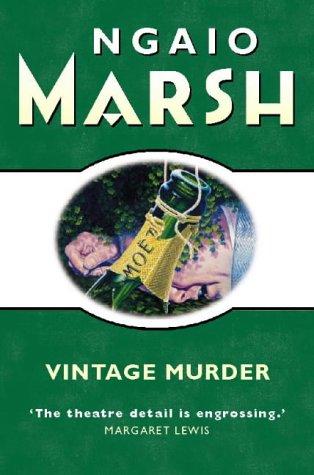
Book Review: Vintage Murder

When I decided to take The Golden Girls Challenge in Bev’s Vintage Mystery Challenge at My Reader’s Block, Ngaio Marsh’s Vintage Murder was one of the first books to go on my reading list. Murder-by-Champagne-bottle sounded so darned classy. But what I hadn’t anticipated was the technical complexity of the mystery presented by Marsh, which made the book quite unique among the others I’ve read for this challenge.

The story is set in New Zealand – famed detective Roderick Alleyn is taking an extended holiday, apparently recovering from some surgery. He winds up sharing a train carriage with a troop of London actors, one of whom recognizes him from a previous case. They befriend him, inviting him to the opening night of their performance and the after-party, celebrating the birthday of company star, Carolyn Dacres. However the party comes to a frothy halt when the theatrically planned release of a jeroboam of Champagne is re-rigged to kill the party host, Dacres’ husband and the owner of the company, Alfred Meyer.

I admit was a bit concerned when the book started with both a diagram of the theater and an extensive list of characters. And I wasn’t wrong in figuring out what this meant – the mystery gave me a lot to track. Marsh apparently started her career in theater, and her extensive knowledge of stagecraft is the key to the murder, as well as its solution. Having no such knowledge, though, I had to go back over the details of the weights and counterweights used to raise and drop scenery more than once. But don't let that put you off. Marsh must have known that readers might find the arcane nature of the crime a bit off-putting, so she helps out the reader with some well-placed letters from Alleyn to his buddy Detective Inspector Fox at Scotland Yard.

Like many books from the time period, this book contains some disturbingly racist and colonialist elements. I’m still amazed by how easily characters in early 20th century novels discuss the inferiority of “brown” people and “colonials,” although I understand it represents the prevailing sentiment of the time – and I agree there’s value in remembering that. There’s particularly dreadful treatment in this book of an English-educated Maori physician, who’s referred to by a local policeman as “ninety per cent civilised.” – and it’s clearly meant to be a compliment. It really made me squirm.

That aside, I think this is a vintage mystery that many readers will love discovering again. I’d especially recommend it for those readers who enjoy a complicated plot. This was my first Ngaio Marsh title, and I definitely plan to read more of her works. So thanks once again to Bev at My Reader’s Block, the host of the Vintage Mystery Challenge. I’ve had a ton of fun with that challenge this summer!

Monday, June 27, 2011

Book Reviews: The Pursuit of Love and Love in a Cold Climate

A while back, I read a review of Nancy Mitford’s Love in a Cold Climate by Bina of If You Can Read This. I had never even heard of Nancy Mitford, but I enjoyed her review, and I popped the book on my Goodreads TBR. And then promptly forgot about it. Until last week, that is. Looking for some books to load on my Kindle before vacation, I saw the title again, and decided to grab it on impulse. Lucky for me! I couldn’t put it down. So after I devoured it, I downloaded the book Mitford wrote first, The Pursuit of Love. I cannot believe it took me this long to discover these little gems: A perfect vacation reading duo!

Both books share a narrator, Fanny Logan Wincham, a well-born young woman who lives on the fringe of aristocratic society due to her parents’ scandalous behavior (her mother’s serial marriages have earned her the moniker “Bolter,” while her father has bucked up his part of the family fortunes by attaching himself to a series of wealthy older women). Through this classic “poor relation,” Mitford provides the reader with a humorous take on a British society that was poised for change in the period between the two World Wars. The books are not about Fanny, however. In each, she is sharing the coming-of-age (read “courtship and marriage”) story of a woman close to her: poised and polished friend Lady Leopoldina (Polly) Hampton in Love in a Cold Climate and cousin and best friend Linda Radclett in The Pursuit of Love.

That’s where the books really diverge, giving each of the books a character all its own. Fanny’s devotion to Linda and her other cousins at Alconleigh makes The Pursuit of Love laugh-out-loud funny, loving and bittersweet. In contrast, her detachment from Polly, an heiress of astounding beauty, and her terror of her conniving mother, Lady Sonia Montdore, is what gives Love in a Cold Climate its legendary bite.

Lady Montdore dominates Love in a Cold Climate, clinging to the status quo for dear life, worrying that any change would threaten “all this,” her generalized term for her wealth, her station, and her comfortable surroundings. Nobody is more aware of Lady Montdore’s importance than Lady Montdore, and her goal is to always remain at the center of society. In one great passage, Fanny details Lady Montdore’s calculations about who got picked up from the train:

Lady Montdore’s writing paper was headed Hampton Place, Oxford, Station Twyfold. But Twyfold, with the change and hour’s wait at Oxford it involved, was only inflicted upon such people as were never likely to be in a position to get their own back on Lady Montdore, anybody for whom she had the slightest regard being met at Oxford. “Always be civil to the girls, you never know who they may marry,” is an aphorism which has saved many an English spinster from being treated like an Indian widow. (p. 18 )

I have read that Love in a Cold Climate was revolutionary in its time for its inclusion of an openly gay character, the Montdore heir Cedric Hampton. And I suppose it was. Over time, however, that characterization seems a bit dated, probably because serious, literary, modern novels are not likely to play a gay character for effeminate laughs. Cedric becomes Lady Montdore’s “sassy gay friend,” which is all well and good, but there were times when the sharing of jewels and make-up made Cedric seem a ridiculous foil for Lady Montdore, rather than an interesting and complex character in his own right.*

Common wisdom refers to Love in a Cold Climate as Mitford’s “best novel,” but I can’t agree. For me, The Pursuit of Love was the more enjoyable of the two, mostly because of the wacky antics of the Radclett cousins and their eccentric father, Uncle Matthew, a country squire of the decidedly old school. Uncle Matthew’s vociferous rages, contempt for all things not English and obsession with hunting are truly hilarious. And the Radclett clan reminded me of the brood from Cheaper by the Dozen, always letting their imaginations lead them into a good time, on the way to a bunch of trouble.

But both books are charming time capsules, bringing the reader right back to a particular time and a very specific part of society that are now largely gone. I loved reading about the “London season” young girls enjoyed – or endured, depending on the girl – while looking for a husband. Both books drip with irony, something I adore. And who knows, had I read them in the correct chronological order, I might have liked Love in a Cold Climate even more than I did. I heartily recommend them both to those who love literary fiction (and even those who usually read historical fiction) with a humorous side. You won’t be disappointed.

Because of Cedric's groundbreaking part in it, Love in a Cold Climate counts toward the GLBT Reading Challenge. And “pursuit” counts as a movement in the What’s in a Name 4 Challenge. Thanks to BethFishReads for hosting!

*If you haven’t seen Second City's wildly popular and irreverent Sassy Gay Friend videos, they involve a character from literature changing her hideous fate with the help of a sassy gay friend. Here’s a link.


Thursday, March 10, 2011

Book Review: Rebecca

I had planned to read Daphne Du Maurier’s Rebecca during A Literary Odyssey’s Read-Along in January. Unfortunately, I experienced a rare Total Library Fail – the wild, snowy conditions kept the book from being transferred between campuses, and I didn’t receive it until the Read-Along was nearly complete. It finally did arrive, though, and since I loved the Laurence Olivier/Joan Fontaine movie, and had always wanted to read the book anyway, I decided to add it to my GLBT Reading Challenge titles.

Du Maurier weaves a wonderful and haunting tale, told completely from the perspective of The Second Mrs. de Winter, Maxim’s young wife. This gives the book the air of a mystery, since the young bride is understandably in the dark about her husband Maxim’s life before she met him. It can also make things difficult on the reader, as The Second Mrs. de Winter is very short on self-esteem, so the reader is sometimes confused by and doubtful of her high society husband’s love for her, just as she is.

No surprise, I really enjoyed the book. But the movie made such a huge impression – and now having read the book I can see how true to the novel the film adaptation was to the book –I’m afraid the novel didn’t have a chance to stand on its own for me. I found my reading of it was totally dominated by the movie – kind of like The Second Mrs. de Winter is dominated by Rebecca. And that’s too bad, because Joan Fontaine was such a lovely actress, and I couldn’t make the frumpy, déclassé Second Mrs. de Winter “be” anyone else, so I think a bit of Du Maurier’s original intention was lost on me.*

There are some differences between the book and the movie, of course. In the book, it’s clear that Manderley is more than a setting – it’s the tangible symbol of the first de Winter marriage. That marriage was dominated by Rebecca, and Manderley remains awash in a wave of scrawling “Rs” attesting to her dominance. She turned Manderley into the showpiece that Maxim always dreamed it could be. So by taking his young wife back to Manderley, Maxim doesn’t actually start a new marriage – he really brings the Second Mrs. de Winter into his and Rebecca’s unresolved union:
Rebecca, always Rebecca. Wherever I walked in Manderley, wherever I sat, even in my thoughts and in my dreams, I met Rebecca. I knew her figure now, the long slim legs, the small and narrow feet. Her shoulders, broader than mine, the capable, clever hands. Hands that could steer a boat, could hold a horse. Hands that arranged flowers, made the modesl of ships, and wrote “Max from Rebecca” on the flyleaf of a book. I knew her face too, small and oval, the clear white skin, the cloud of dark hair. I knew the scent she wore, I could guess her laughter and her smile. If I heard it, even among a thousand others, I should recognise her voice. Rebecca, always Rebecca. I should never be rid of Rebecca. pg. 232

You can just feel the young bride’s distress and frustration in du Maurier’s evocative writing, can’t you?

And that’s really what I feel I got most out of finally reading Rebecca: an appreciation of du Maurier’s considerable writing abilities. I loved the way she slowly built the story through the narrator’s undependable narration. I am anxious to read Jamaica Inn now, as I haven’t seen either the movie or TV adaptation.

So I have finally knocked one book off for the GLBT Challenge! I’m glad I made small commitments to such a wide range of challenges this year, because it’s really pushing me to read some books I’ve neglected until now, like this one. Thanks to Amanda, Christina and Jen for hosting!


*This is why I’m a firm believer in book-before-movie timing! Gone with the Wind wouldn’t have been the same book if I’d been primed with wimpy Leslie Howard while I was reading it the first time. Why would Scarlett have fallen to pieces over him? When I read it, I had Robert Redford in mind – handsome and romantic, but also capable of toughness. I know, I know, but give me a break, I was reading it in the 70s.

Tuesday, March 8, 2011

Audiobook Review: Miss Pettigrew Lives for a Day

If a book can be distilled to a chapter, a chapter distilled to a sentence, and a sentence distilled to a word, then the word for Winifred Watson’s Miss Pettigrew Lives for a Day is “charming.” I listened to Frances McDormand’s narration of the audiobook, and I have to say it was wonderful.

Miss Pettigrew is the literary equivalent of a screwball comedy, and it’s easy to see why Persephone Books chose to pluck it from obscurity. Unemployed and unaccomplished governess Guinevere Pettigrew reports to what she believes is an interview for another dull position, only to be thrust into the glittering high society world of actress Delysia LaFosse. Miss Pettigrew quickly becomes an ally to Miss LaFosse, and an asset to her circle of friends, because of her quick wits and straight-forward style.

The book takes place over a one-day period, and we watch the dowdy, downtrodden Miss Pettigrew blossom with every small triumph. She can hardly believe her luck, and dreads the end of the wonderful day, when she believes all her fun must come to an end:

For years she had lived in other people’s houses, and had never been an inmate in the sense of belonging. And now, in a few short hours, she was blissfully and serenely at home. She was accepted. They talked to her. And how they talked. She had never heard the like before. Their ridiculous inconsequence. Every sentence was like a heady cocktail. The whole flavor of the remarks gave her a wicked feeling of sophistication. And the way she kept her end up. No one would ever dream that she was new to it. “I never believed,” thought Miss Pettigrew with pride, “that I had it in me.” (1:54:58, Audiobook).

You can’t help but root for Miss Pettigrew to embrace this new lifestyle on a permanent basis!

I imagine this was a rather racy book when it was first published in 1938, what with Miss LaFosse maintaining three love affairs at one time – I suppose that’s what makes it feel so “modern,” overall. However, it also contains some shocking cultural signs of its times, including ethnic slurs aimed at Italians and Jews, that are decidedly out of step in 2011. The character of Miss Pettigrew – the spinster who’s sure life has passed her by, only to find she may have one last chance at happiness – is truly timeless.

Frances McDormand, who played Miss Pettigrew in the 2008 movie (I haven’t seen it, but would really like to), reads this book beautifully. You can practically watch prim Miss Pettigrew’s hair come down through her narration. The men are gruff, but not overdone. The women’s voices are all very unique, and capture their personalities perfectly. This was really a perfect match between book and reader – McDormand’s comic timing enhances the book tremendously. I highly recommend it for those who love literary fiction, humor, and fiction about women. And if you’re thinking of trying an audiobook for the first time, I would definitely suggest this one – it will give you an idea of how pleasant the experience of listening to a book can be. This is one of only four Persephones available as audiobooks, and I certainly hope they will do more.

This book counts for a Life Stage in the What's in a Name 4 Challenge. Thanks to Beth Fish Reads for hosting. I'll be posting a link to this review on Audiobook Jukebox – if you’re looking for audiobook reviews, that’s the best place to start!


Tuesday, February 22, 2011

Audiobook Review: Old Filth

Jane Gardam’s Old Filth is a portrait of successful barrister at the end of his life. To outsiders, Sir Edward Feathers’ journey appears to have been uneventful, charmed even. He attended a boarding school for young gentlemen during the Great Depression, served in a prestigious unit deployed in the English countryside in World War II, read law at Oxford directly after the war, and was admitted to the bar quickly. His legal success was legendary, his marriage was long and happy, his wealth was enviable. Gardam emphasizes this “outsider” view by starting each of the parts of the book with a dramaturgical scene, with acquaintances discussing Feathers in the format of a play: scene setting and character names followed by lines.

Of course, the interior life doesn’t match the exterior, and Gardam reveals the hidden sorrows of Eddie’s life through a present, first-person narrative and disjointed flashbacks in the days after his wife’s sudden death. We slowly learn about his miserable life as a “Raj orphan,” one of the thousands of children sent back at the age of 4 or 5 from the British Empire’s outposts in tropical Asia to be fostered by perfect strangers, who were paid to bring them up in the English way.

We also learn about the preternatural fear of homosexuality that the boarding school culture engendered. “Sir,” Eddie’s headmaster, impresses on the boy from the start that he runs a “clean school.” His friendship with another boy, Pat Ingelsby, is suspect, and it appears that the schools went to great lengths to keep young men from forming close and exclusive friendship, for fear that they signaled something “unsavory.” Not surprisingly, his childhood experiences leave Eddie emotionally distant and distrustful.

Gardam’s use of language is spare and evocative. Eddie’s seemingly serene life winds up packed with adventure, pain, and loss. The subject matter is heavy, but like all lives, there are wry moments, as when we learn why Sir Edward coined his own nickname (“Filth” stands for Failed in London, Try Hongkong). There’s plenty of irony too, as the least “savory” characters he’s met in his life prove to be the closest things he ever has to real friends.

The Raj orphan phenomenon was new to me. I found myself wondering why their parents bothered to have children that they had no intention of raising, but I suppose it made perfect sense at the time. Gardam paints a pretty unflattering portrait of the British Empire bureaucrats, who cannot seem to get far enough away from England, but don’t seem to be able to leave it truly behind and embrace the warm and sensuous cultures in which the find themselves.

The book was very good, but I did have some definite problems with it. The stream of consciousness musings were often disjointed. This may have been particularly pronounced as I listened to the audiobook, narrated by Graeme Malcom. The dramaturgical passages, especially, were read so fast that I felt some of their meaning was lost. Old Filth is a great character, but some of the plot twists rang false, and one or two interesting storylines simply petered out. I waffled between 3 and 4 stars on this book, but in the end it came down to enjoyment – I simply didn’t enjoy listening to it as much as I have other recent audiobooks. Gardam shares a great story, though, and I wouldn’t hesitate to read The Man in the Wooden Hat, which recounts the Feathers’ marriage from his wife Betty’s point of view. But I will read it, not listen. I’m not sure Gardam’s complex style is the right fit for an audiobook for me. Her work appears to take more concentration than I can muster at the gym, which is how I generally fit audiobooks in to my schedule.

Tuesday, June 15, 2010

Wives and Daughters: Accessible Victorian


Like so many American public high school graduates, my knowledge of Victorian literature can basically be summed up in one word: Dickens. I have nothing against Charles Dickens. A Tale of Two Cities is a classic for a reason: it’s a really great story of love and lust and revenge, once you get past the archaic writing style. But one thing I remember hating about Dickens’ writing was the pathetic characterizations of women. Lucy Manette fainted at every important juncture of her life. Nell Trent’s saccharine persona induced nausea. The female villains were more interesting: both Madame DeFarge and Miss Havisham are iconic baddies, but only Miss Havisham can claim any kind of complexity. So when I saw SRC task 20.3, which required reading a Victorian era novel, I decided that expanding my definition of “Victorian literature” might be the key to actually enjoying the task.

Enter Elizabeth Gaskell, like her friend Dickens a writer who was originally published in serial format. Looking through the reviews, I settled on her last novel, Wives and Daughters, because I liked the descriptions of the female characters – words like “feisty,” “scandalous,” “conniving,” and “imperious” sounded promising. Again, by going outside of my comfort zone I have been rewarded.

Wives and Daughters is the story of Molly Gibson, the motherless daughter of a well-respected country doctor. When Molly becomes the object of affection of one of her father’s medical students, her father decides that he needs a woman in the house to manage the proprieties. So he marries Hyacinth (Clare) Fitzpatrick, a widow who was once the governess of the local lord’s children. Mr. Gibson considers her a very good match because she has a daughter, Cynthia, who is just a bit older than Molly. However, Molly’s one previous interaction with the doctor’s new wife indicates that her character is less caring and generous than it appears on first glance.

Gaskell puts the day-to-day life of women at the forefront of Wives and Daughters, and the detailed descriptions of their routines, chores and meetings provide a kind of social history of the period. A tremendous amount of time was spent on chores; even more seems to have been spent on communications, either in person or by letter. It’s clear from the book that people considered making visits and providing interesting conversation both a virtue and a duty. But what really struck me was how the detailing of those daily routines could say so much about the power structure of Victorian society. For example, I was surprised by the complete lack of independence that young women had within the family structure. Molly’s new stepmother could keep her from paying a visit to a desperately sick friend, just so that she didn’t have to go unaccompanied on one of her visits. I can’t even imagine asking my daughter to change plans unless an emergency presented itself – my how times have changed.

Molly’s interactions with other characters illustrate her position within the hierarchical structure of the town. Being a Victorian novel, a lot of this information comes in discussions of the suitability of potential mates. Squire Hamley and his wife initially consider Molly an unsuitable match for their treasured sons, although they come to love her like a daughter. Mr. Preston, who oversees Lord Hollingford’s properties, represents a poor match for Cynthia, despite her lack of wealth, as her social-climbing mother counts on her beauty to provide an advantageous marriage. Second son Roger Hamley cannot consider marriage to any woman until he finds employment, as the family estate is entailed to his older brother, Osborne. Osborne, for his part, keeps his marriage to a French Catholic woman of modest means a secret, to avoid being disinherited.

Boundaries are less rigid than they appear at first however – Gaskell’s characters both struggle with and reshape the boundaries, although the likeable characters do so out of virtue and the less likeable out of conceit.

Perhaps I found this book so appealing because of the well-developed and complex female characters, something I have not found in other Victorian novels I have read. Molly, the book’s heroine, is certainly virtuous, but not syrupy. Like other great female characters, she has flaws, pride and self-consciousness among them. She quickly opens her mouth to defend the people she loves, even at the risk of being rude. She knows what she should do, and Gaskell portrays her struggle to do it in a very powerful way. In contrast, her step-sister Cynthia is the most interesting and enigmatic figure in the book – she is absolutely aware of her own faults, and conscious and respectful of Molly’s sweet and naïve nature. She sees everyone – including herself – exactly as they are. In the hands of a clumsier writer, Cynthia might have been a “bad” character used to emphasize Molly’s “goodness.” But Gaskell exhibits a deep understanding of the pressures on women to make their way in a society designed by and for men. Through Cynthia, Gaskell provides a dispassionate look at the position of women in Victorian society, and chronicles someone who played the hand she was dealt extremely well, according to the mores of the time.

I really liked this book. One discovery of my summer reading seems to be a growing affinity for female authors, regardless of their culture or time period. I am growing more demanding in my expectations of portrayals of women, maybe because I have a better idea of how really difficult it is to be one than I did when I was younger. Another gift for expanding my reading horizons.