Showing posts with label Vintage Mystery Reading Challenge. Show all posts

Friday, December 9, 2011

Book Review: Phoebe Taylor Atwood’s The Cape Cod Mystery

I took this book out of the library twice previously this year, and had to return it for one reason or another. But the third time was a charm for Phoebe Taylor Atwood and me, because The Cape Cod Mystery, the first of her Asey Mayo series, wound up being my favorite book for this year’s Vintage Mystery Challenge, hosted by Bev at My Reader’s Block.

Author Dale Sanborn takes a cottage in Cape Cod to escape the summer heat and work on his latest sensational novel. But he can’t escape the many people who are furious that he’s used thinly veiled versions of their own lives to people his books. Sanborn turns up dead hours after he runs over wealthy Bill Porter’s beloved dog – and the only clue seems to be a can of sardines, a type the local dry goods store stocks especially for Porter, making him the prime suspect. The sleepy little seaside town doesn’t even have a jail (can you imagine when the Cape was so remote?), so the local sheriff puts poor Porter in the stocks (the actual stocks left over from the Pilgrims, no less). Porter puts his life in the hands of the man he trusts most in the world: Asey Mayo, a former sailor with a long and probably jaded past. Mayo sets out to find the real killer in a weekend to avoid Bill winding up in a big time Massachusetts prison.

The murder represents a good mystery, but Mayo is what makes the book great. At first he appears to be just an ordinary old handyman for a large estate. But Atwood quickly reveals a man with a near-encyclopedic memory and a veritable Rolodex of personal acquaintances from all walks of life who are ready to help him solve the mystery. He’s totally smart without being a bit flamboyant – kind of an anti-Poirot. His dialogue is written in dialect, so you can really get a feel for his strong New England accent, which I absolutely loved, because it doesn’t seem condescending – just spot on. Reading it really did make me think of those great accents you hear Down East in Maine, where I used to spend my summers.

The best thing about joining this year’s Vintage Mystery Challenge was pushing myself to read seven different female authors. I found a whole new set of writers to seek out in addition to Atwood, including Ngaio Marsh, Dorothy L. Sayers and Margery Allingham. So thanks a million Bev for hosting. I’m already working on my own “Vicious Vacations” list for 2012!

Monday, September 5, 2011

Book Review: Margery Allingham’s The Crime at Black Dudley

Another first for this summer: my first Albert Campion mystery. Margery Allingham’s books have been on my radar screen for a while, but Bev’s Vintage Mystery Challenge finally put one in my hands.

I decided to start with Campion’s first appearance on the literary scene, The Crime at Black Dudley. The choice here was deliberate, but debatable. Campion is a significant character* in the novel, but he is not the protagonist – some Campion enthusiasts apparently don’t count this as a Campion mystery at all. Still, I reasoned that if his cameo in one novel led to the larger gig, I wanted to see why.

The story revolves around a house party arranged by Wyatt Petrie to entertain his invalid uncle by marriage, Colonel Gordon Coombe, who is living out his last years in the family’s ancient, secluded castle, Black Dudley. Petrie arranges for a lively set of stylish young people to share the country weekend, including his friend George Abbershaw, an eminent young pathologist. The very serious Abbershaw has uncharacteristically wrangled an invitation because he is smitten with Meggie Oliphant, another member of the party. Also along is the affable and outrageous Albert Campion – who everyone assumes is someone else’s guest at the party. In addition, Petrie’s uncle has a few – very surly – friends in attendance.

So the stage is set for the lights to go out.

And right on cue, they do just that! Petrie suggests the group reenact the family ritual of the Black Dudley Dagger, a grown-up game of “Hot Potato” played with a bejeweled blade that is passed throughout the house in the pitch dark. The loser is the one left holding the dagger when the lights come on, so everyone is frantically trying to pass it.** When the lights come on, Petrie’s uncle has been whisked away – it turns out he’s been stabbed. And his surly companions want Abbershaw to sign a phony death certificate.

So who killed the uncle? And why are the surly companions threatening to kill everyone else if they can’t find a lost item? And what’s in the brief case Campion is fighting with the chauffer about? And while we’re at it, who the heck is Albert Campion? I’m not telling, but Allingham does make a very interesting thriller of it.

Unfortunately from my perspective, as clever as it all is, she doesn’t really give the reader a chance to solve the mystery. I think this may be related to the fact that she started off with one hero – Abbershaw – and ended up with two, as Campion played out his quirky, baffling part in the story’s ultimate resolution.

I liked this book, but didn’t love it. My main problem was that I found it disjointed. The members of the weekend party were unevenly developed, giving the mystery a strange slant: you couldn’t focus attention on all of the players, because there wasn’t enough information to go on. I did like the gothic elements though: the secret passages, the strange lady in the attic, the unexplained car in the garage all made for a very atmospheric read. And I definitely liked the Campion character enough to read one of Allingham’s other books.

Okay, that’s my sixth Golden Girls read for the Vintage Mystery Challenge. I’m planning to finish up with Phoebe Atwood Taylor’s The Cape Cod Mystery, which will make for seven different Golden Girls read in the challenge, six of whom were brand new to me! This has been a lot of fun, so thanks Bev! And since it’s a mystery, I’m also linking to the RIP Challenge, even though this wasn’t one of the two books I was planning. Hmmm. Maybe I can get to four after all… No, no mustn’t overcommit! But we’ll see.

*And believe me, “character” is the right word for Campion in this book. Little wonder he caught the attention of the public – and the publishers.
**This leads to a lot of running around in the dark with sharp objects, something at which all mothers reading this book will doubtless shake their heads, anticipating imminent disaster. They will be correct.


Friday, July 8, 2011

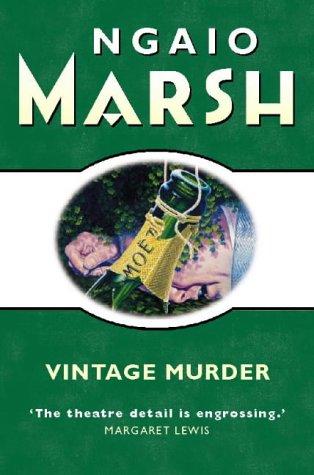
Book Review: Vintage Murder

When I decided to take The Golden Girls Challenge in Bev’s Vintage Mystery Challenge at My Reader’s Block, Ngaio Marsh’s Vintage Murder was one of the first books to go on my reading list. Murder-by-Champagne-bottle sounded so darned classy. But what I hadn’t anticipated was the technical complexity of the mystery presented by Marsh, which made the book quite unique among the others I’ve read for this challenge.

The story is set in New Zealand – famed detective Roderick Alleyn is taking an extended holiday, apparently recovering from some surgery. He winds up sharing a train carriage with a troop of London actors, one of whom recognizes him from a previous case. They befriend him, inviting him to the opening night of their performance and the after-party, celebrating the birthday of company star, Carolyn Dacres. However the party comes to a frothy halt when the theatrically planned release of a jeroboam of Champagne is re-rigged to kill the party host, Dacres’ husband and the owner of the company, Alfred Meyer.

I admit was a bit concerned when the book started with both a diagram of the theater and an extensive list of characters. And I wasn’t wrong in figuring out what this meant – the mystery gave me a lot to track. Marsh apparently started her career in theater, and her extensive knowledge of stagecraft is the key to the murder, as well as its solution. Having no such knowledge, though, I had to go back over the details of the weights and counterweights used to raise and drop scenery more than once. But don't let that put you off. Marsh must have known that readers might find the arcane nature of the crime a bit off-putting, so she helps out the reader with some well-placed letters from Alleyn to his buddy Detective Inspector Fox at Scotland Yard.

Like many books from the time period, this book contains some disturbingly racist and colonialist elements. I’m still amazed by how easily characters in early 20th century novels discuss the inferiority of “brown” people and “colonials,” although I understand it represents the prevailing sentiment of the time – and I agree there’s value in remembering that. There’s particularly dreadful treatment in this book of an English-educated Maori physician, who’s referred to by a local policeman as “ninety per cent civilised.” – and it’s clearly meant to be a compliment. It really made me squirm.

That aside, I think this is a vintage mystery that many readers will love discovering again. I’d especially recommend it for those readers who enjoy a complicated plot. This was my first Ngaio Marsh title, and I definitely plan to read more of her works. So thanks once again to Bev at My Reader’s Block, the host of the Vintage Mystery Challenge. I’ve had a ton of fun with that challenge this summer!

Tuesday, May 17, 2011

Book Review: The Mill Mystery

I have really been enjoying the The Golden Age Girls challenge, one of the challenge levels in Bev’s Vintage Mystery Challenge at My Reader’s Block. And considering I joined that one late, I’m making pretty good progress so far. Partly that’s because I love having a mystery on my Kindle, so I can sneak a few pages in while I’m waiting for children at activities, or waiting for the pressure cooker to de-pressurize, or waiting for a doctor/dentist/hair appointment.* But my idea to read 5 different vintage authors made the Kindle a liability. Neither the Ngaio Marsh nor the Phoebe Atwood Taylor titles I wanted were available for Kindle. My search finally lead me to The Classic Mystery Collection, more than 100 complete mystery novels in one Kindle title. And the list of authors included two vintage authors I had never read: Anna Katharine Green and Mary Roberts Rinehart. And the price? $2.99!**

I began with Green’s The Mill Mystery. Written in 1886, I would not call this a “detective” story – even an amateur detective story. The book is more mysterious than mystery, following Constance Sterling slowly piece together the reasons behind the seemingly unrelated deaths of a popular local minister and the richest man in town. When we meet Constance, she is “a young woman of twenty-five, without home, relatives, or means of support, having in her pocket seventy-five cents of change, and in her breast a heart like lead, so utterly had every hope vanished in the day’s rush of disappointments.” Before Constance’s kind and gentle roommate, the secret fiancée of the minister, dies within hours of hearing the news of his death, she begs Constance to clear her fiancée’s name from the inevitable rumors of suicide that will flow from his drowning in a vat at the abandoned mill.

The reason that I say the book is more “mysterious” than “mystery” is that Constance doesn’t actively set out to deduce a solution to the mystery. Most of the answer simply falls into her lap, in the form of an extraordinarily detailed letter. She did ferret out some of the details, but I think the long letter device was weak, and made the story look particularly antiquated. The book has some other problems from my personal perspective. There’s way too much Victorian feminine fragility for my taste – in fact, it’s the device that moves the main story along. The love story is rather predictable – once I was able to tell the two Pollard brothers apart, I was pretty sure who the “good” guy was.

So The Mill Mystery is a truly “vintage” title, more reminiscent of Wilkie Collins’ work than a classic Agatha Christie whodunit. It does have the virtue of being a very early mystery work by a female writer who was a best-seller during her own lifetime, and it certainly gives you an idea of how the mystery genre has developed since the Victorian era. In fairness, Green’s most famous work is The Leavenworth Case, and I probably should have started there. Still, if you loved The Woman in White, this might be up your alley.

Thanks again to Bev for hosting The Vintage Mystery Challenge!


*You get the idea. I do a lot of waiting. As in three books worth of waiting in the past two months.

**I’m going to admit that this is a poorly formatted Kindle title – each book is treated as a “chapter,” so searching is a pain. And I can’t figure out what to do about the “farthest page read” sync when I shift around from book to book. But for $2.99, it’s nice to always have a mystery I haven’t read waiting in the wings!

Saturday, April 2, 2011

Vintage Sleuth Reviews: Lord Peter Wimsey and Hercule Poirot

I’m BA-ACK!

For the past two weeks, my real life has gotten in the way of my virtual life. It’s understandable, of course, but I’ve really missed having the time to write and to read what everyone else is writing. My reading didn’t stop though, so clearly I’ve got some catching up to do, review-wise. That’s why I’m pairing up two of crime-writing’s greatest detectives in today’s post.

I’m looking forward to stopping by and seeing what everyone’s been up to lately!

Whose Body?

I had so much fun with my first title for My Reader’s Block’s Vintage Mystery Reading Challenge that I decided to find the next “Golden Girl” title available on Kindle and have it on my device before I could say “Whodunnit?” Luckily, a couple of Dorothy L. Sayers’ titles are now available for e-readers, and since I’m that person who likes to start at the beginning of a series, I ordered the book that introduced Lord Peter Wimsey to the mystery-loving world: Whose Body?.

I’d read mixed reviews about the book, most from people who seemed to love the series, but thought that the first book was a kind of “trial run” for Sayers. Well, if it gets better from here, that’s great, because I enjoyed it quite a bit.

The mystery is intriguing. A naked – well, naked aside from a pince-nez, that is –and completely unfamiliar body is found in the bathtub of a London architect. At the same time, a wealthy Jewish businessman disappears. Both men are known to Lord Peter Wimsey’s darling mother, the Dowager Duchess of Denver, so the amateur detective is dragged into the investigations.

I guessed the murderer early in this one, but not the means, so I can see why some people might call the book clumsy. But it’s the characters that make the book so memorable: the affable, disarming Wimsey; his faithful and multitalented servant, Bunter; the earnest Scotland Yard investigator, Charles Parker. I was a bit distracted by Sayers’ rendering of Wimsey’s accented English – I really couldn’t imagine what it was supposed to sound like, it appeared more Cockney than upper-crusty to me. Still, I’m looking forward to following Wimsey and his colleagues through more marvelous murder and mayhem.
Taken at the Flood

So while I was on a mystery roll, I turned to an unfamiliar title by a familiar “Golden Girl”: Agatha Christie’s Taken at the Flood. In this book, Hercule Poirot must solve a mystery that he unknowingly saw set in motion two years before, during a World War II air raid.

The Cloade family has always lived under the protection of their fabulously successful brother, Gordon Cloade. When Gordon is killed during the London blitz, his brand new wife Rosaleen inherits his entire estate, since he has not had time to modify his will. She and her antagonistic brother, David Hunter, take up residence in the Cloade’s hometown, Warmsley Vale, and the relationship between the newcomers and the Cloade Clan is uneasy – Rosaleen’s life is all that stands between Gordon’s extended family and their financial security. However it isn’t Rosaleen’s death, but the death of an unknown, blackmailing drifter who called himself Enoch Arden, that brings Poirot to town.

The mystery is particularly interesting for the specific time and place it evokes, England immediately after World War II. It’s easy to forget how long it took for England to recover after the war, and the vagaries of the unstable phone system and the stresses of the post-War economy figure heavily in the plot of the novel. Characteristic of Christie’s more popular titles, there is a large cast of potential murderers, but they aren’t as fully developed as in her other books. The victims are not as colorful as they might have been either. The solution is ingenious, though, and I hadn’t guessed it, so I’d call the book enjoyable – just not one of Poirot’s best outings.

Both of these books are for the Vintage Mystery Challenge. Thanks to My Reader’s Block for hosting!

Saturday, March 12, 2011

Hipster vs. Vintage Book Reviews: A Red Herring Without Mustard and Behold, Here's Poison

Within the past week I read two mysteries, Alan Bradley’s A Red Herring Without Mustard and Georgette Heyer’s Behold, Here’s Poison. Both of them were enjoyable, but very different. In fact, they really provided such a contrast in approach that I thought I’d review them together, because I think the comparisons say a lot about the individual authors’ styles.

I read Red Herring first. I’ve been waiting for it since I finished the second installment in the series The Weed that Strings the Hangman’s Bag, and it arrived on my Kindle the day it was released. Chemistry genius cum sleuth Flavia de Luce is thirteen now, still dueling wits with her (increasingly vile) sisters and trying to figure out her aloof father. Flavia’s first-person narration makes the series, frankly. She’s impetuous, sassy, and shrewd. But she’s also a child, so she doesn’t always completely understand the complex motives of the people around her. And she’s a bit sad and lonely, motherless because of her adventurous mother’s death when she was a baby. It makes for an oddly sympathetic combination – you just wish you could hug her, and tell her it’s going to be alright, but you know she’d blanch at the idea!

This time, Flavia is out to solve two crimes that she guesses are related: the beating of a gypsy who Flavia had invited to stay on a remote piece of the family estate, Buckshaw, and a the murder of local “tough” Brookie Harewood, whose body was artfully placed in the arms of Poseidon in a Buckshaw fountain. In the process she has to navigate a secretive sect of religious dissenters, the Hobblers, a ferocious London gypsy girl, and the estate’s arcane water system.

Red Herring is a mystery with lots of style. Because it’s part of a series, the characters are evolving in interesting ways, as Flavia begins to understand them more clearly. We are starting to see, for example, how very much Flavia’s father loves his family – and how very desperate he is to hold on to the family estate, which is at risk because of the onerous death duties owed to the government after his wife’s untimely death. Flavia’s sisters, Ophelia and Daphne, are evolving too, but in far less sympathetic fashion – in fact, I thought their evil was a bit “cartoonish” in this book. Inspector Hewitt’s fondness and respect for Flavia is growing, but so is his worry that she may be putting herself in danger. But the mystery itself in this one wasn’t so fantastic, I’m afraid. The chemistry tie-in was really weak, and the revelation of the murderer was anticlimactic. As for the title, I still don’t quite understand to what it alludes – unless it’s the fact that there are far more red herrings than actual clues to help the reader figure out the mystery. But it is a great title, isn’t it?

I followed up with my first book for My Reader’s Block’s Vintage Mystery Reading Challenge. Georgette Heyer was not a name at all familiar to me – in fact, many of the female names on the list were unfamiliar – so I signed up for The Golden Girls Challenge, decided to read at least 5 different authors, and started investigating.


Behold, Here’s Poison is a classic, country estate mystery. It’s so 1930s – everyone dressed for dinner, speaking wittily, loathing each other with class. The Matthews family, run by their tyrannical Uncle Gregory, is not at all unhappy when he winds up dead – except for the fact that it appears one of them must have done it. Oily Randall Matthews, Gregory’s heir, seems a likely murderer – but he has an air-tight alibi. Mrs. Zoe Matthews and Miss Harriett Matthews both hoped to inherit his house, and have something of their own, finally. Mrs. Matthews’ children, Guy and Stella, are tired of having their uncle derail their life decisions. Did they kill him? There are other family members, and even neighbors, with axes to grind. The cast of characters is extensive, and the formality of address – Miss Matthews, Mrs. Matthews, Mr. Matthews –had me re-reading at the beginning to make sure I knew who was who, but the characters had such well developed personalities that the confusion didn’t last for long. In fact, the only character I found kind of dull was Inspector Hannasyde, the Scotland Yard detective in charge of the investigation. His personality hardly develops at all, but maybe that’s just as well, as it lets the suspects shine.

The mystery is the key thing in this book. It’s so darn clever. The clues were there, but I really didn’t see it coming, which is what I love in a mystery. It’s clear that Heyer did her research – the murder weapon is a surprise, very unique and devious. So I’d say this mystery is all about substance. The dialog is good, the characters are well-drawn, but in the end it’s the crime you remember, not what surrounds it. It was a great find.

Both of these mysteries were 4 star reads, for completely different reasons. Neither was a 5 star, though, because neither delivered the complete package: style and substance. Both authors are obviously capable of it though, and I’m anxious to read more from both authors. Thanks to Bev at My Reader’s Block for hosting!