Showing posts with label mystery. Show all posts

Monday, October 28, 2013

THE BIG CLOCK by Kenneth Fearing

A murder investigation in which the investigator already believes he knows who the murderer is – and yet realizes he himself is being framed for the crime. He has to keep the investigation going long enough to reveal the murderer before the murderer realizes he was recognized. That is the taut, electrifying premise of Ken Fearing’s noir NYRB Classic The Big Clock.

George Stroud, editor of Crimeways magazine, is not a nice person. Despite the fact he has a sweet wife and an adorable kid (both nicknamed “George”), he begins a casual affair with his boss’ girlfriend, Pauline. After dropping her off from a clandestine weekend, he spies his boss following her up the stairs to her apartment. Two days later the cleaning lady finds she’s been murdered. George’s boss, publishing mogul Earl Janoth, tasks George with tracking down the killer – but all clues lead back to Pauline’s lover, who just happens to be George. The rest of the book is a study in tension, as George follows the steps that will inevitably lead to revealing himself as Pauline’s lover, thereby destroying his home life, his job, and quite possibly his life, if Janoth is the real killer.

I looked out the windows myself. There was a lot of territory out there. A nation within a nation. If I picked the right kind of a staff, twisted the investigation where I could, jammed it where I had to, pushed it hard where it was safe, it might be a very, very, very long time before they found George Stroud. p. 90

This short novel, told through multiple narrators who sound like witnesses giving testimony, really packs a punch. It’s fun to watch George, the sleazy philanderer who thought he covered his tracks so well, come to realize how easy his actions were to trace. Part of the giveaway comes in George’s peculiar taste in art, which was fine. But I really didn’t get why Fearing included the perspective of the artist in the novel. I thought it confused a very tight plot.

It’s easy to see why this is a noir classic, however, and a perfect choice for both the R.I.P. VIII Challenge and the Classics Club. That makes four for this season’s R.I.P. Challenge, but I’m still hoping to review one more before the week is out! Thanks so much to Carl V. for hosting! This is the first of the NYRB Classics on my Classics Club List I have gotten to, and I am happy I have so many of these once out-of-print titles on my TBR pile. They add an element of mental detective work to my reading, wondering why they went out of fashion in the first place.

FTC Statement: I did not receive a copy of this book for review. I borrowed it from the library. That brings my Classic Club average cost per book down to $3.07!

Friday, August 2, 2013

MY FRIEND MAIGRET by Georges Simenon

There is something very comforting about a classic police procedural. A corpse shows up at the beginning of the mystery – often accompanied by an exotic murder weapon or ornate crime scheme – and by the end the murderer is delivered to justice by either the keen intellect or daring intuition of some hardworking police detective. Writers as diverse as Ngaio Marsh (New Zealand), Erle Stanley Gardner (USA), Maj Sjowall and Per Wahloo (Sweden), and Peter Robinson (UK) have all delivered on the same concept for more than a century, all adding something unique to the formula – often in the understanding of how very different the legal systems in which the detectives operate actually are.

It makes sense that the French would have a unique take on the genre. And by some accounts, Georges Simenon’s Inspector Maigret remains the quintessential French police detective, even though he made his debut in the 1930s. My Friend Maigret was my second novel in the series (both read completely out of order). I enjoyed this one, not because the mystery was so fantastic, but because it gave me a great deal of insight into some of the inherent differences between the French and British legal systems. This was because Maigret spends the book being shadowed by Mr. Pyke of Scotland Yard, who has been sent to study Maigret’s crime solving “methods.”

In this case, Maigret gets a call from Inspector Lechat on Île de Porquerolles indicating that a local ne’er-do-well has been murdered on the same night he was overheard bragging in a bar about his “good friend,” the famous inspector Maigret. The Inspector does indeed remember Marcellin, a man who he put away for taking part in an inveigling scheme – and his TB-ridden accomplice, Ginette, whom Maigret took pity on, and sent to a sanatorium. At one point, Maigret discusses the relationships that develop between habitual criminals and the police with Pyke:

“I wrote to him, I recall. I don’t know how you deal with them in your country.

“Very correctly.”

“I don’t doubt it. Here we sometimes knock them around. We’re not always gentle with them. But the odd thing is that they seldom hold it against us. They know we’re only doing our job. From one interrogation to the next, we get to know each other.”

“This is the one who called himself a friend of yours?”

“I’m convinced he was sincere.”

Kindle location 173/2176
Intrigued by his alleged link to the thug’s death, and relieved to have an interesting case to work on with Pyke, Maigret heads off to beautiful Porquerolles. And meets the colorful locals and strange boating tourists. And drinks white wine. And observes. Actually, it looks like nothing is happening. And then all of a sudden he has the mystery solved. I’m not sure what Pyke learned about his methods, but I know I didn’t learn much. Still the motive was pretty clever – I just didn’t feel like I was gathering the same clues Maigret had in the end.

I said at a dinner party recently that I found murder mysteries very relaxing, and everybody laughed. I wasn’t actually joking. Sure, depending on the era and country in which they operate, these fictional heroes have different constraints, and different social ills with which they contend. Not to mention murder. But to my mind, what ties police procedurals together is a belief that somehow front line civil servants – at least most of them – are trying their hardest to protect the public. My Friend Maigret certainly falls into that category. And while in this case the ending wasn’t as satisfying as usual – either for me, or for Maigret – I still find something very comforting about that.

FTC disclosure: I did not receive a copy of this book for review.

Thursday, July 5, 2012

Audiobook Review: COLOUR SCHEME by Ngaio Marsh

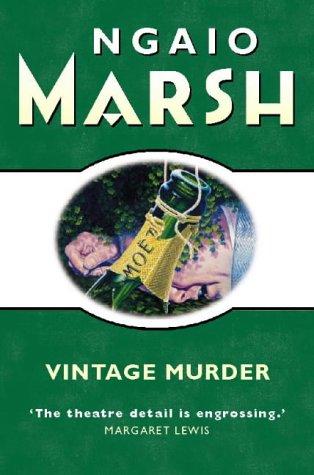
I fell in love with Ngaio Marsh last year when I read Vintage Murder for the Vintage Mystery Challenge. How can you not love a writer who devises a death-by-champagne-bottle plot? So when I put together this year’s list for the Vintage Mystery Challenge 2012, I created a “Vicious Vacations” theme (murders that take place in a location I’d kill to visit!), and knew I had to put another of Marsh’s New Zealand-based books on the list. The only one I was able to find on audible was Colour Scheme, so I downloaded it. And it finally came up on my gym cue last week. The fact that I logged an extra hour and a half on the treadmill indicates that my second Marsh title didn’t disappoint.

Maurice Questing is an insufferable, conniving, lascivious man. A long-term resident of Wai Atta Tapu*, a small thermal spring resort, it’s clear from the beginning that Questing has some kind of hold over Colonel and Mrs. Claire, the stuffy but good hearted expats who own the spa. The book takes place during World War II, and the daily blackouts and shipping reports that were part of the daily life of New Zealanders at the time feature prominently in the book. The setting allows Marsh to put together a fascinating group of characters and possible motives for Questing’s inevitable – and quite gruesome – murder.

In addition to the Claires and Questing, other expats include the Claire’s adult children, ugly duckling Barbara and son Simon, who is working to perfect his Morse code in advance of being called up to the air force. There’s also the famous (and high-maintenance) Shakespearean actor who is taking a cure of lumbago in the mud baths, Geoffrey Gaunt, along with his entourage: personal secretary named Dikon Bell, a New Zealander, and his British dresser and man-Friday, Calley. Another guest at the hot springs, Septimus Falls, is totally agreeable, but evasive about his background. Spa handyman Smith is known to hate Questing openly, even accusing him of attempted homicide.

One of the things that made this book particularly interesting was the inclusion of Maori characters, including a retired Member of Parliament, Rua. Marsh treated the Maori characters and their traditions with dignity, while still illustrating the tensions between the three cultures: Brits, “colonials,” and native New Zealanders. One of the possible premises for Questing’s murder stems directly from the Maori element in the novel, since he is accused of stealing Maori artifacts for illicit sale to collectors. The second premise is indirectly related to the Maori, as there appears to be a fifth column spy signaling from the Maori reserve lands where Questing is known to wander in the evenings.

I never figured out the murderer, in part because I didn’t pay as much attention to the title as I should have. There are a couple of interesting twists toward the end, and more than a few red herrings, but I love it when I think back and the solution to a mystery was difficult but fair, which has been the case in both of the Marsh titles I have read. I’d call it good fun.

I am finally on the board for another challenge, Vintage Mystery Reading Challenge 2012, hosted by Bev at My Reader’s Block! I have some catching up to do, but that’s what summer is for, isn’t it?

*An apology – since I listened to the audiobook, and couldn’t find a complete list of characters online, I have likely spelled some names wrong. I have gone with the most common spellings.

Friday, December 9, 2011

Book Review: Phoebe Taylor Atwood’s The Cape Cod Mystery

I took this book out of the library twice previously this year, and had to return it for one reason or another. But the third time was a charm for Phoebe Taylor Atwood and me, because The Cape Cod Mystery, the first of her Asey Mayo series, wound up being my favorite book for this year’s Vintage Mystery Challenge, hosted by Bev at My Reader’s Block.

Author Dale Sanborn takes a cottage in Cape Cod to escape the summer heat and work on his latest sensational novel. But he can’t escape the many people who are furious that he’s used thinly veiled versions of their own lives to people his books. Sanborn turns up dead hours after he runs over wealthy Bill Porter’s beloved dog – and the only clue seems to be a can of sardines, a type the local dry goods store stocks especially for Porter, making him the prime suspect. The sleepy little seaside town doesn’t even have a jail (can you imagine when the Cape was so remote?), so the local sheriff puts poor Porter in the stocks (the actual stocks left over from the Pilgrims, no less). Porter puts his life in the hands of the man he trusts most in the world: Asey Mayo, a former sailor with a long and probably jaded past. Mayo sets out to find the real killer in a weekend to avoid Bill winding up in a big time Massachusetts prison.

The murder represents a good mystery, but Mayo is what makes the book great. At first he appears to be just an ordinary old handyman for a large estate. But Atwood quickly reveals a man with a near-encyclopedic memory and a veritable Rolodex of personal acquaintances from all walks of life who are ready to help him solve the mystery. He’s totally smart without being a bit flamboyant – kind of an anti-Poirot. His dialogue is written in dialect, so you can really get a feel for his strong New England accent, which I absolutely loved, because it doesn’t seem condescending – just spot on. Reading it really did make me think of those great accents you hear Down East in Maine, where I used to spend my summers.

The best thing about joining this year’s Vintage Mystery Challenge was pushing myself to read seven different female authors. I found a whole new set of writers to seek out in addition to Atwood, including Ngaio Marsh, Dorothy L. Sayers and Margery Allingham. So thanks a million Bev for hosting. I’m already working on my own “Vicious Vacations” list for 2012!

Monday, September 5, 2011

Book Review: Margery Allingham’s The Crime at Black Dudley

Another first for this summer: my first Albert Campion mystery. Margery Allingham’s books have been on my radar screen for a while, but Bev’s Vintage Mystery Challenge finally put one in my hands.

I decided to start with Campion’s first appearance on the literary scene, The Crime at Black Dudley. The choice here was deliberate, but debatable. Campion is a significant character* in the novel, but he is not the protagonist – some Campion enthusiasts apparently don’t count this as a Campion mystery at all. Still, I reasoned that if his cameo in one novel led to the larger gig, I wanted to see why.

The story revolves around a house party arranged by Wyatt Petrie to entertain his invalid uncle by marriage, Colonel Gordon Coombe, who is living out his last years in the family’s ancient, secluded castle, Black Dudley. Petrie arranges for a lively set of stylish young people to share the country weekend, including his friend George Abbershaw, an eminent young pathologist. The very serious Abbershaw has uncharacteristically wrangled an invitation because he is smitten with Meggie Oliphant, another member of the party. Also along is the affable and outrageous Albert Campion – who everyone assumes is someone else’s guest at the party. In addition, Petrie’s uncle has a few – very surly – friends in attendance.

So the stage is set for the lights to go out.

And right on cue, they do just that! Petrie suggests the group reenact the family ritual of the Black Dudley Dagger, a grown-up game of “Hot Potato” played with a bejeweled blade that is passed throughout the house in the pitch dark. The loser is the one left holding the dagger when the lights come on, so everyone is frantically trying to pass it.** When the lights come on, Petrie’s uncle has been whisked away – it turns out he’s been stabbed. And his surly companions want Abbershaw to sign a phony death certificate.

So who killed the uncle? And why are the surly companions threatening to kill everyone else if they can’t find a lost item? And what’s in the brief case Campion is fighting with the chauffer about? And while we’re at it, who the heck is Albert Campion? I’m not telling, but Allingham does make a very interesting thriller of it.

Unfortunately from my perspective, as clever as it all is, she doesn’t really give the reader a chance to solve the mystery. I think this may be related to the fact that she started off with one hero – Abbershaw – and ended up with two, as Campion played out his quirky, baffling part in the story’s ultimate resolution.

I liked this book, but didn’t love it. My main problem was that I found it disjointed. The members of the weekend party were unevenly developed, giving the mystery a strange slant: you couldn’t focus attention on all of the players, because there wasn’t enough information to go on. I did like the gothic elements though: the secret passages, the strange lady in the attic, the unexplained car in the garage all made for a very atmospheric read. And I definitely liked the Campion character enough to read one of Allingham’s other books.

Okay, that’s my sixth Golden Girls read for the Vintage Mystery Challenge. I’m planning to finish up with Phoebe Atwood Taylor’s The Cape Cod Mystery, which will make for seven different Golden Girls read in the challenge, six of whom were brand new to me! This has been a lot of fun, so thanks Bev! And since it’s a mystery, I’m also linking to the RIP Challenge, even though this wasn’t one of the two books I was planning. Hmmm. Maybe I can get to four after all… No, no mustn’t overcommit! But we’ll see.

*And believe me, “character” is the right word for Campion in this book. Little wonder he caught the attention of the public – and the publishers.
**This leads to a lot of running around in the dark with sharp objects, something at which all mothers reading this book will doubtless shake their heads, anticipating imminent disaster. They will be correct.


Tuesday, August 9, 2011

Blog Relay for Dorte Hummelshøj Jakobsen’s The Cosy Knave: Answer to Question 8

Today I have the baton in the blog relay for Dorte Hummelshøj Jakobsen’s new novel, The Cozy Knave. I'm revealing the answer to question number 8. And question number 9 follows. You will have to follow the link below to find out the answer to number 9! What a great idea for a book launch interview, don’t you think?

Yesterday’s question was: What makes your cosy cosy?

As question 2 indicates, I began plotting and writing The Cosy Knave almost out of the blue. Of course I had some vague ideas about what constituted a cosy, but shortly before I embarked on my new subgenre, I consulted a blogger who is a real expert so I had a chance of getting it right. These days, all rules are there to be challenged, of course, still I thought it would be a good idea to stick to these five rules of thumb:

a) an amateur sleuth with a useful job or position, but also someone who can get help from the police when she needs it: the librarian Rhapsody, engaged to the local constable.
b) a suitable setting: a small village where everybody knows everybody else, including their sordid - or silly - secrets, the kind of place that tend to make you forget that the good, old days never really existed.
c) the right kind of crimes, meaning a couple of murders are all right, as long as the readers are spared the dirty truths about the shock and pain they cause. For once, bloodthirsty old Macbeth got it right when he said: "If it were done when ´tis done then ´twere well it were done quickly´.
d) plenty of quirky characters: readers will expect prattling dog walkers, stuck-up mushroom ´experts´, taciturn farmers and constables called Smith, Wesson and Winchester.
e) finally, the traditional cosy is expected to be free of sex scenes and swearing - so this is the perfect gift for granny, your young daughter, or anyone who likes having their crime candied.


Thanks, Dorte, for letting me participate! I cannot wait to read your new book!

So here is the next question in the relay:

9) Do you consider yourself a cosy mystery writer, or do you plan to publish in other sub-genres?

To find out the answer, you will have to head to Clarissa Draper´s blog tomorrow!

Thursday, August 4, 2011

Audiobook Review: The Sunday Philosophy Club

CAUTION: Snarky Review Ahead. Because Isabel Dalhousie annoyed the heck out of me!

Having enjoyed a number of the No. 1 Ladies Detective Agency books by the same author, my husband and I downloaded Alexander McCall Smith’s The Sunday Afternoon Philosophy Club for a recent drive to Chicago. I’d heard the main character in the series, Isabel Dalhousie, was an academic, and we both thought that might make for an interesting twist on her sleuthing. We started the audiobook somewhere in Central Pennsylvania.

When it finished up as we cruised past Chicago’s U.S. Cellular Field, my hubby turned to me and deadpanned, “Well, that’s eight and a half hours of our lives we’ll never get back.” Indeed.

First books in series are difficult – rather than focusing on the mystery at hand, authors often wind up focusing on “setting up” the characters and their relationships. I get that. But in this case the main mystery and the subplot mysteries were very thin – and were solved through serendipity. Isabel Dalhousie didn’t demonstrate any great intellectual prowess or cultural acumen in solving the problems, just a combination of nosiness and dumb luck.

As for her characterization, the whole discussion of her work as a journal editor was off-putting to me. I know a couple of extraordinarily hard-working academic journal editors – at least one of whom is a pretty regular reader of this blog. Most of them do the job against the background of their own considerable work as professors and researchers. It’s a huge undertaking, not the dilettantish endeavor that McCall Smith makes it out to be. Phew — getting a manuscript in the mail. And then actually sending it out to a couple of reviewers. Excellent day’s work – time for a glass of wine and an omelet with the favorite niece’s old beau. Well done.

But what annoyed me most about Isabel Dalhousie went beyond the subpar mystery and the thinness of the characters. Rather than entertaining me, I had the impression that the Scottish journal editor was lecturing me the entire time. Me and everyone else who came within her general vicinity: family, friends, servants, dog walking strangers. I know Alexander McCall Smith is an ethicist. But what about the ethics of badgering your readers? What about the ethics of acting like a smartypants? This isn’t Sophie’s World, for crying out loud. It’s supposed to be a cozy mystery, not a lecture from a Problem of Evil course. I just couldn’t get over the disturbing flashbacks to freshman year at college.

(No wonder her Sunday Philosophy Club never meets. I can just imagine a club member's calculus on a sunny Sunday morning. “What shall I do on this beautiful Edinburgh day? Well, I could amble through the Royal Botanical Garden. Maybe take in the Ceilidh Culture Festival. Or I could go over to Isabel Dalhousie’s and be hit over the head with a Kantian imperative. Hmmm. The Royal Botanical Garden it is then.”)

Narrator Davina Porter does her absolute best with this audiobook, let me underscore that. She executes a wide range of characters skillfully and credibly. I especially liked her characterization of the men in the book – very engaging, and each very different. I just don’t think she had a lot to work with in this case. I would happily listen to her read another title – just not in this series!

After I finished the book I looked at some other reviews, and they were all over the board. Some people love the series, and some just hate it. Count me among the peeved.

SNARK ATTACK OVER!

Friday, July 8, 2011

Book Review: Vintage Murder

When I decided to take The Golden Girls Challenge in Bev’s Vintage Mystery Challenge at My Reader’s Block, Ngaio Marsh’s Vintage Murder was one of the first books to go on my reading list. Murder-by-Champagne-bottle sounded so darned classy. But what I hadn’t anticipated was the technical complexity of the mystery presented by Marsh, which made the book quite unique among the others I’ve read for this challenge.

The story is set in New Zealand – famed detective Roderick Alleyn is taking an extended holiday, apparently recovering from some surgery. He winds up sharing a train carriage with a troop of London actors, one of whom recognizes him from a previous case. They befriend him, inviting him to the opening night of their performance and the after-party, celebrating the birthday of company star, Carolyn Dacres. However the party comes to a frothy halt when the theatrically planned release of a jeroboam of Champagne is re-rigged to kill the party host, Dacres’ husband and the owner of the company, Alfred Meyer.

I admit was a bit concerned when the book started with both a diagram of the theater and an extensive list of characters. And I wasn’t wrong in figuring out what this meant – the mystery gave me a lot to track. Marsh apparently started her career in theater, and her extensive knowledge of stagecraft is the key to the murder, as well as its solution. Having no such knowledge, though, I had to go back over the details of the weights and counterweights used to raise and drop scenery more than once. But don't let that put you off. Marsh must have known that readers might find the arcane nature of the crime a bit off-putting, so she helps out the reader with some well-placed letters from Alleyn to his buddy Detective Inspector Fox at Scotland Yard.

Like many books from the time period, this book contains some disturbingly racist and colonialist elements. I’m still amazed by how easily characters in early 20th century novels discuss the inferiority of “brown” people and “colonials,” although I understand it represents the prevailing sentiment of the time – and I agree there’s value in remembering that. There’s particularly dreadful treatment in this book of an English-educated Maori physician, who’s referred to by a local policeman as “ninety per cent civilised.” – and it’s clearly meant to be a compliment. It really made me squirm.

That aside, I think this is a vintage mystery that many readers will love discovering again. I’d especially recommend it for those readers who enjoy a complicated plot. This was my first Ngaio Marsh title, and I definitely plan to read more of her works. So thanks once again to Bev at My Reader’s Block, the host of the Vintage Mystery Challenge. I’ve had a ton of fun with that challenge this summer!

Wednesday, June 29, 2011

Audiobook Review: In the Company of Cheerful Ladies

Alexander McCall Smith’s sixth installment in the No. 1 Ladies Detective Agency series, In the Company of Cheerful Ladies, has a wonderfully intimate feel. Each of the mysteries covered in this book is very personal to the characters that series fans have already come to know and love. The book starts with Mma Ramotswe attempting to foil a theft in the bizarre. Then there’s the mystery of the intruder in her house on Zebra Drive. And the question of the perfect pumpkin left on her porch. Most importantly, there’s the strange goings-on at Mr. J.L.B. Matekoni’s former residence – and the chance that they may have something to do with ladies’ man apprentice Charlie. As with all of the books in this series, the mysteries themselves are secondary to the human interactions and observations that lead to their resolutions.

Since the first book was published in 1998, McCall Smith has had plenty of time to develop the main characters, and their increasing complexity is indeed part of the charm of the book. We see Precious Ramotswe’s lingering self-doubt for the first time in the series. And we experience Grace Makutsi’s loneliness – after all, even if you can be justifiably proud of your astounding 97% result on the final examinations at the Botswana Secretarial College, you can’t cuddle up with it at night.

But McCall Smith isn’t letting things get dull in Gabarone. This book introduces two important male characters: Phuti Radiphuti, Mma Makutsi’s kind but clumsy dancing partner, and Mr. Polopetsi, a very honest man who paid a terrible price for someone else’s mistake, and is now trying to find work in an unforgiving city. As ever, I love the compassion with which McCall Smith treats his characters.

One of the reasons I chose this for what I knew would be a long car ride was because it was read, like the other books in this series, by South African narrator Lisette Lecat. Her beautifully accented reading evokes warm sunshine, African bush tea, and the slow but changing rhythm of life near the Kalahari Desert– probably because she grew up not far from Botswana. She is Precious Ramotswe to me. And Grace Makutsi. And Mr. J.L.B. Matekoni. I can easily listen to her for hours, forgetting (or at least trying to forget) the demolition derby driving on the Capitol Beltway. Lecat’s range is outstanding. Each of the voices she creates is so distinctive that I no longer need the text to tell me who’s speaking. And unlike other readers’, I haven’t found any of her characterizations off-putting, even those of the minor or transitory ones.

These audiobooks have wide appeal, and because the themes are very traditional, and morality and culture are discussed often, they make a great choice for family listening. My husband and at least one daughter enjoy them as much as I do. Highly recommended for lovers of mysteries, lovers of fiction set in other countries, and people who love smart, compassionate, female protagonists.

Audiobook Jukebox

This book wasn’t for any of my challenges, but I will be linking this review to Audiobook Jukebox, a great place to find audiobook reviews and recommendations. June was Audiobook Month, so I really wanted to get something linked over there before the end of the month!

Tuesday, May 17, 2011

Book Review: The Mill Mystery

I have really been enjoying the The Golden Age Girls challenge, one of the challenge levels in Bev’s Vintage Mystery Challenge at My Reader’s Block. And considering I joined that one late, I’m making pretty good progress so far. Partly that’s because I love having a mystery on my Kindle, so I can sneak a few pages in while I’m waiting for children at activities, or waiting for the pressure cooker to de-pressurize, or waiting for a doctor/dentist/hair appointment.* But my idea to read 5 different vintage authors made the Kindle a liability. Neither the Ngaio Marsh nor the Phoebe Atwood Taylor titles I wanted were available for Kindle. My search finally lead me to The Classic Mystery Collection, more than 100 complete mystery novels in one Kindle title. And the list of authors included two vintage authors I had never read: Anna Katharine Green and Mary Roberts Rinehart. And the price? $2.99!**

I began with Green’s The Mill Mystery. Written in 1886, I would not call this a “detective” story – even an amateur detective story. The book is more mysterious than mystery, following Constance Sterling slowly piece together the reasons behind the seemingly unrelated deaths of a popular local minister and the richest man in town. When we meet Constance, she is “a young woman of twenty-five, without home, relatives, or means of support, having in her pocket seventy-five cents of change, and in her breast a heart like lead, so utterly had every hope vanished in the day’s rush of disappointments.” Before Constance’s kind and gentle roommate, the secret fiancée of the minister, dies within hours of hearing the news of his death, she begs Constance to clear her fiancée’s name from the inevitable rumors of suicide that will flow from his drowning in a vat at the abandoned mill.

The reason that I say the book is more “mysterious” than “mystery” is that Constance doesn’t actively set out to deduce a solution to the mystery. Most of the answer simply falls into her lap, in the form of an extraordinarily detailed letter. She did ferret out some of the details, but I think the long letter device was weak, and made the story look particularly antiquated. The book has some other problems from my personal perspective. There’s way too much Victorian feminine fragility for my taste – in fact, it’s the device that moves the main story along. The love story is rather predictable – once I was able to tell the two Pollard brothers apart, I was pretty sure who the “good” guy was.

So The Mill Mystery is a truly “vintage” title, more reminiscent of Wilkie Collins’ work than a classic Agatha Christie whodunit. It does have the virtue of being a very early mystery work by a female writer who was a best-seller during her own lifetime, and it certainly gives you an idea of how the mystery genre has developed since the Victorian era. In fairness, Green’s most famous work is The Leavenworth Case, and I probably should have started there. Still, if you loved The Woman in White, this might be up your alley.

Thanks again to Bev for hosting The Vintage Mystery Challenge!


*You get the idea. I do a lot of waiting. As in three books worth of waiting in the past two months.

**I’m going to admit that this is a poorly formatted Kindle title – each book is treated as a “chapter,” so searching is a pain. And I can’t figure out what to do about the “farthest page read” sync when I shift around from book to book. But for $2.99, it’s nice to always have a mystery I haven’t read waiting in the wings!

Saturday, April 2, 2011

Vintage Sleuth Reviews: Lord Peter Wimsey and Hercule Poirot

I’m BA-ACK!

For the past two weeks, my real life has gotten in the way of my virtual life. It’s understandable, of course, but I’ve really missed having the time to write and to read what everyone else is writing. My reading didn’t stop though, so clearly I’ve got some catching up to do, review-wise. That’s why I’m pairing up two of crime-writing’s greatest detectives in today’s post.

I’m looking forward to stopping by and seeing what everyone’s been up to lately!

Whose Body?

I had so much fun with my first title for My Reader’s Block’s Vintage Mystery Reading Challenge that I decided to find the next “Golden Girl” title available on Kindle and have it on my device before I could say “Whodunnit?” Luckily, a couple of Dorothy L. Sayers’ titles are now available for e-readers, and since I’m that person who likes to start at the beginning of a series, I ordered the book that introduced Lord Peter Wimsey to the mystery-loving world: Whose Body?.

I’d read mixed reviews about the book, most from people who seemed to love the series, but thought that the first book was a kind of “trial run” for Sayers. Well, if it gets better from here, that’s great, because I enjoyed it quite a bit.

The mystery is intriguing. A naked – well, naked aside from a pince-nez, that is –and completely unfamiliar body is found in the bathtub of a London architect. At the same time, a wealthy Jewish businessman disappears. Both men are known to Lord Peter Wimsey’s darling mother, the Dowager Duchess of Denver, so the amateur detective is dragged into the investigations.

I guessed the murderer early in this one, but not the means, so I can see why some people might call the book clumsy. But it’s the characters that make the book so memorable: the affable, disarming Wimsey; his faithful and multitalented servant, Bunter; the earnest Scotland Yard investigator, Charles Parker. I was a bit distracted by Sayers’ rendering of Wimsey’s accented English – I really couldn’t imagine what it was supposed to sound like, it appeared more Cockney than upper-crusty to me. Still, I’m looking forward to following Wimsey and his colleagues through more marvelous murder and mayhem.
Taken at the Flood

So while I was on a mystery roll, I turned to an unfamiliar title by a familiar “Golden Girl”: Agatha Christie’s Taken at the Flood. In this book, Hercule Poirot must solve a mystery that he unknowingly saw set in motion two years before, during a World War II air raid.

The Cloade family has always lived under the protection of their fabulously successful brother, Gordon Cloade. When Gordon is killed during the London blitz, his brand new wife Rosaleen inherits his entire estate, since he has not had time to modify his will. She and her antagonistic brother, David Hunter, take up residence in the Cloade’s hometown, Warmsley Vale, and the relationship between the newcomers and the Cloade Clan is uneasy – Rosaleen’s life is all that stands between Gordon’s extended family and their financial security. However it isn’t Rosaleen’s death, but the death of an unknown, blackmailing drifter who called himself Enoch Arden, that brings Poirot to town.

The mystery is particularly interesting for the specific time and place it evokes, England immediately after World War II. It’s easy to forget how long it took for England to recover after the war, and the vagaries of the unstable phone system and the stresses of the post-War economy figure heavily in the plot of the novel. Characteristic of Christie’s more popular titles, there is a large cast of potential murderers, but they aren’t as fully developed as in her other books. The victims are not as colorful as they might have been either. The solution is ingenious, though, and I hadn’t guessed it, so I’d call the book enjoyable – just not one of Poirot’s best outings.

Both of these books are for the Vintage Mystery Challenge. Thanks to My Reader’s Block for hosting!

Saturday, March 12, 2011

Hipster vs. Vintage Book Reviews: A Red Herring Without Mustard and Behold, Here's Poison

Within the past week I read two mysteries, Alan Bradley’s A Red Herring Without Mustard and Georgette Heyer’s Behold, Here’s Poison. Both of them were enjoyable, but very different. In fact, they really provided such a contrast in approach that I thought I’d review them together, because I think the comparisons say a lot about the individual authors’ styles.

I read Red Herring first. I’ve been waiting for it since I finished the second installment in the series The Weed that Strings the Hangman’s Bag, and it arrived on my Kindle the day it was released. Chemistry genius cum sleuth Flavia de Luce is thirteen now, still dueling wits with her (increasingly vile) sisters and trying to figure out her aloof father. Flavia’s first-person narration makes the series, frankly. She’s impetuous, sassy, and shrewd. But she’s also a child, so she doesn’t always completely understand the complex motives of the people around her. And she’s a bit sad and lonely, motherless because of her adventurous mother’s death when she was a baby. It makes for an oddly sympathetic combination – you just wish you could hug her, and tell her it’s going to be alright, but you know she’d blanch at the idea!

This time, Flavia is out to solve two crimes that she guesses are related: the beating of a gypsy who Flavia had invited to stay on a remote piece of the family estate, Buckshaw, and a the murder of local “tough” Brookie Harewood, whose body was artfully placed in the arms of Poseidon in a Buckshaw fountain. In the process she has to navigate a secretive sect of religious dissenters, the Hobblers, a ferocious London gypsy girl, and the estate’s arcane water system.

Red Herring is a mystery with lots of style. Because it’s part of a series, the characters are evolving in interesting ways, as Flavia begins to understand them more clearly. We are starting to see, for example, how very much Flavia’s father loves his family – and how very desperate he is to hold on to the family estate, which is at risk because of the onerous death duties owed to the government after his wife’s untimely death. Flavia’s sisters, Ophelia and Daphne, are evolving too, but in far less sympathetic fashion – in fact, I thought their evil was a bit “cartoonish” in this book. Inspector Hewitt’s fondness and respect for Flavia is growing, but so is his worry that she may be putting herself in danger. But the mystery itself in this one wasn’t so fantastic, I’m afraid. The chemistry tie-in was really weak, and the revelation of the murderer was anticlimactic. As for the title, I still don’t quite understand to what it alludes – unless it’s the fact that there are far more red herrings than actual clues to help the reader figure out the mystery. But it is a great title, isn’t it?

I followed up with my first book for My Reader’s Block’s Vintage Mystery Reading Challenge. Georgette Heyer was not a name at all familiar to me – in fact, many of the female names on the list were unfamiliar – so I signed up for The Golden Girls Challenge, decided to read at least 5 different authors, and started investigating.


Behold, Here’s Poison is a classic, country estate mystery. It’s so 1930s – everyone dressed for dinner, speaking wittily, loathing each other with class. The Matthews family, run by their tyrannical Uncle Gregory, is not at all unhappy when he winds up dead – except for the fact that it appears one of them must have done it. Oily Randall Matthews, Gregory’s heir, seems a likely murderer – but he has an air-tight alibi. Mrs. Zoe Matthews and Miss Harriett Matthews both hoped to inherit his house, and have something of their own, finally. Mrs. Matthews’ children, Guy and Stella, are tired of having their uncle derail their life decisions. Did they kill him? There are other family members, and even neighbors, with axes to grind. The cast of characters is extensive, and the formality of address – Miss Matthews, Mrs. Matthews, Mr. Matthews –had me re-reading at the beginning to make sure I knew who was who, but the characters had such well developed personalities that the confusion didn’t last for long. In fact, the only character I found kind of dull was Inspector Hannasyde, the Scotland Yard detective in charge of the investigation. His personality hardly develops at all, but maybe that’s just as well, as it lets the suspects shine.

The mystery is the key thing in this book. It’s so darn clever. The clues were there, but I really didn’t see it coming, which is what I love in a mystery. It’s clear that Heyer did her research – the murder weapon is a surprise, very unique and devious. So I’d say this mystery is all about substance. The dialog is good, the characters are well-drawn, but in the end it’s the crime you remember, not what surrounds it. It was a great find.

Both of these mysteries were 4 star reads, for completely different reasons. Neither was a 5 star, though, because neither delivered the complete package: style and substance. Both authors are obviously capable of it though, and I’m anxious to read more from both authors. Thanks to Bev at My Reader’s Block for hosting!


Saturday, January 22, 2011

Audiobook Review: One Corpse Too Many

The New Year’s resolution to rock a bathing suit for my 20th anniversary trip to the Caribbean has been thoroughly productive from one perspective: the audiobook perspective, that is. Looking for something light and engaging enough to keep my mind off the treadmill miles, I chose the second Brother Cadfael mystery, One Corpse Too Many. As expected, it was very entertaining.


Set against the backdrop of the siege of Shrewsbury Castle during the dynastic struggles of King Stephen and Empress Maude, the novel follows the scrupulous Brother Cadfael’s search for the murderer of a minor noble whose death was not warranted by King Stephen, unlike the other 94 men of the castle who were brutally but legally hanged for their participation in the siege: the “one corpse too many” of the title.


What I love about the Brother Cadfael novels is the unfolding of the deductive reasoning process. The unorthodox monk, who lived the worldly life of a Crusader before taking up the cowl to tend the abbey’s herbarium, brings his life’s experience to bear on every problem. And this book presents a lot of problems. Along with the solving of a murder, Cadfael also must save the life of a courier, outwit the cagiest of nobles, protect a young woman from the King, and hide the truth about a crime from an innocent orphan.


One of the most charming parts of the audiobook for me was Patrick Tull’s excellent narration. His accent changes from heavy Welsh to proper British falsetto effortlessly. And his voice is soothing, but not at all dull. As mysteries go, this is good, clean, historical fun. I liked this one even better than A Morbid Taste for Bones, and I think it would stand on its own, even if you didn’t read the first one. This book is highly recommended for lovers of deductive mysteries and historical mysteries.


This is my first book for the What's In A Name 4 Challenge: A Number. It's such a fun challenge, and the categories are so open that you can always fill them with something you wanted to read anyway, but didn't make time for. Thanks to Beth Fish Reads for hosting. And it clears some of my backlog, so it's a Bloggiesta chore as well!


Sunday, October 17, 2010

Elementary, my dear Mummy-ji: The Case of the Missing Servant


The only thing that will clear Vish Puri’s client of murder is a task that would daunt Sherlock Holmes himself: find one woman with an unknown last name on the whole of the Indian sub-continent. But then Sherlock Holmes could never have imagined the exhaustive knowledge India’s most private investigator has of the country’s customs, cultures and people. Tarquin Hall’s The Case of the Missing Servant, the first of the Vish Puri mysteries, introduces readers to the amazing deductive powers of the detective known to his friends as “Chubby,” along with the characters and technologies that make his business a success.

Puri is a traditional man living in a changing world, modern-day New Delhi. But that’s not to say that he’s out of touch. The description of his office evokes his respect for the past and the present:
The room’s focal point, however, was the shrine in the far corner. Two portraits hung above it, both of the draped in strings of fresh marigolds. The first was a likeness of Puri’s guru, the philosopher-statesman, Chanakya, who lived three hundred years before Christ and founded the arts of espionage and investigation. The second was a photograph of the detective’s late father, Om Chander Puri, posing in his police uniform on the day in 1963 when he was made a detective. (p. 14)

In fact, Hall’s genius is in his understanding that while the façade of India is transforming, the soul of the country remains very much the same. Puri capitalizes on both his knowledge of New India – BPOs, love marriages, real estate millionaires – and his intimate understanding of the old – the Arthashastra, hijras, tribal societies – to solve his cases.

Along with Puri, whose mustaches and self-satisfaction reminded me of Hercule Poirot, Hall offers up a cast of offbeat and mostly likeable characters, including Facecream, the agency’s intrepid female operative, Rinku, the slightly shady best friend from Puri’s youth, and Mummy-ji, the detective’s indomitable, sleuthing mother. I imagine these characters will take on even greater roles as the series develops.

From my reading of the first book in each series, I would say that there are a lot of similarities between the Vish Puri mysteries and those of another British ex-pat writing about murder and mayhem in a former colony, namely Alexander McCall Smith’s No. 1 Ladies’ Detective Agency series. Both series feature detectives working in traditional, polyglot societies that are in a state of rapid development. Both series are written by men who clearly have an intimate knowledge of the culture, although they are not members of it. Both shy away from vogue goriness and focus on the cerebral aspects of detective work. I have enjoyed the first books in both of these series, and would recommend them to mystery lovers (especially lovers of old-style mysteries), and those who love to read books about other cultures.

But honestly, the cultural scholar in me wonders about how well these cultural observers are doing. How would an Indian react to Vish Puri or a Botswanan to Precious Ramotswe? Have these characters been “Anglicized for my protection?” That’s what I can’t know. (As a New Yorker, I sense “outsider” as soon as an author has a “Brooklynite” put ketchup on a hot dog – for god’s sake, who would do such a thing? The author must be from Kansas, I think.) So I’d love to hear from anyone in India or Africa that has read these books. How well have the outsiders captured the cultures for those of us who can only dream of going to such places? It doesn’t make the mysteries any less enjoyable, but it would be nice to know.

Saturday, September 25, 2010

More peril in Scandinavia: Smilla's Sense of Snow


Smilla Jasperson doesn’t belong in Copenhagen. She was born in Greenland and raised by her Inuit mother, from whom she learned everything about snow and ice. But after her mother’s death, her estranged Danish father brought her to Copenhagen, where as an adult she lives a solitary, callous, irascible existence, except for her friendship with a poor Inuit boy, Isaiah. When Isaiah falls off the roof to his death, even though she knows he is terrified of heights, she suspects foul play. The authorities quickly close the case, and she realizes someone with a lot of power doesn’t want the murder solved, so she sets out to do it on her own.

Peter Hoeg’s Smilla’s Sense of Snow presents the reader with a difficult protagonist in a difficult situation. She is already an outsider, a sensory-oriented woman in a verbal society. She is uncomfortable with language (her native tongue is leaving her, but she has never been quite comfortable with Danish), and her first person narration reflects that anxiety. In fact, the narration is so frustratingly incomplete that it feels almost antagonistic at times:
“He has a collection of aftershave lotions and eau de toilette that smell expensive and sweetly alcoholic: I open them and put a dab of the fragrance on a paper napkin, which I then roll into a ball and put in the pocket of my smock, to flush down the toilet later on. I’m looking for something specific, but I don’t find it. Or anything else of interest, either.” (page 268).

The reader is being kept in the dark deliberately, because Smilla won’t – or can’t – share.

I can see why some people give up on this book. It’s non-linear and cryptic, with important pieces of information tossed in as asides. The story hangs on some elaborate coincidences, and some giant leaps of logic move the reader through the “clues” to solve the mystery.

I liked the book, though. As someone who normally looks at snow only as a potential traffic hazard and school delayer, I found Smilla’s meticulous observations of ice absorbing. I wondered who Hoeg got to explain ice and snow to him in such painstaking detail. I also liked the author’s descriptions of the uneasy relationship between the government of Denmark and Greenland’s Inuit peoples, which are scattered throughout book. The social commentary on contemporary Danish society was fascinating.

I would recommend this book for those wanting another dose of Scandinavian Noir – Smilla’s contrary, outsider sensibility has something in common with Lisbeth Salander's. Also to those who like titles that explore the perspectives of different cultures. But that recommendation comes with a caveat: if your satisfaction with a mystery depends on a tidy resolution, this may not be the title for you.

So more peril from Scandinavia finishes my fifth book in the Scandianvian Reading Challenge – only one more to go! And it also counts for the RIP Challenge, so only one to go to complete Peril the First. Now for some grading – the sooner it’s done, the sooner I can get back to the books!

Sunday, September 5, 2010

The No. 1 Ladies’ Detective Agency: Solving African mysteries, great and small

Botswana is suddenly on my Bucket List, and it’s all because of Precious Ramotswe.

I had already put Alexander McCall Smith’s The No.1 Ladies’ Detective Agency on my reading list for the R.I.P. V Challenge when Karen over at How Mysterious gave a great review to the second audio book in that series. With a trip to New Jersey looming, and a 1-book credit on audible.com burning a hole in my digital pocket, I decided to download the audio book.

Another great call, Karen.

Precious Ramotswe is a gatherer – a gatherer of people, a gatherer of skills and a gatherer of information. A non-traditional woman in a traditional but changing society, Mma Ramotswe takes her inheritance and puts her considerable deductive powers to work by opening Botswana’s first female owned and operated detective agency. As a new business owner, she takes almost any case that comes her way, from tracking down pampered pooches to exposing insurance cheats. She constructs each case as a puzzle, and she uses her knowledge of Botswana –culture, flora, fauna, history – to make the pieces of the puzzle fit.

I especially loved the idea of having Precious solve lots of different mysteries, rather than have the book dominated by one case: you got to know her and the supporting cast of characters better as you encounter both her successes and failures during her first months on the job. And there’s a good deal of humor to go along with the sleuthing, because Precious can both laugh at herself and laugh at the world.

This is a particularly engaging audio book. With Lisette Lecat’s African-accented narration, the story truly springs to life. I loved Lecat’s graceful pronunciation of the Setswanan names, and the changes in her voice that signaled different characters were consistent, clear and never cutesy. The only thing I might have wished for was some of the sounds of Botswana – fires crackling at a cattle station, traditional music drifting from a neighbor’s turntable, birds calling from the thorn bushes.

It’s been a long time since a book prompted me to think about traveling to some way-out destination, but I found myself trolling the Internet for photo safaris in Botswana when I got home from New Jersey today. That’s the transportational power of a good read in action.

Tuesday, July 27, 2010

Even when you hate a book you learn something

This summer, in my post-tenure euphoria, I have dedicated myself to expanding my reading horizons: meeting new authors, sampling new genres, and, most gratifying, making a few new friends along the way. One of the ways I have pushed my boundaries is by joining some reading challenges, including the voluminous Summer 2010 Reading Challenge at Goodreads. I figured reading the reviews of favorite books was a great way to expand my own TBR list.

This is how I first encountered the term “cozy murder.” Certainly, I read some Miss Marple books as a kid, and I watched Jessica Fletcher solve the murders of the Cabot Cove natives, who were slaughtered at a seemingly higher rate than Maine’s summer mosquito population. But I didn’t know there was A) a name for this kind of light mystery, and B) a proliferation of series in this “by women, for women mayhem” vein. My feminist sensibilities were intrigued, and I do love a good mystery now and then, so I tracked down one of the most ballyhooed series – the Hannah Swensen mysteries by Joanne Fluke – and got busy with The Chocolate Chip Cookie Murder.

But this post is not a rant about a poorly conceptualized and overly written beach book. (My alter-ego, Acerbi-Col, might have to share this sentence about the cat: "Moishe's favorite activities when she was gone were eating and napping." Really? Do I need to know this? Now if Moishe played the concertina, that would be worth mentioning. But napping? A cat? You get the idea.) Instead, today’s post is about accepting that there are some roads you just haven’t taken, and aren’t going to take. Some groups you can never be part of. Some jokes you are never going to get. And that’s actually okay with me, finally.

Is that a leap from forcing myself to read one (admittedly, well-loved) book from a whole genre? I guess so. My first reaction after finishing The Chocolate Chip Cookie Murder was this: “What am I not getting?” If thousands of people like this kind of thing, why can’t I enjoy it? But as I mulled it over, my reaction quickly evolved to this: “What do I need from reading that this book didn’t provide?” And that’s a much better question. Because there’s a difference between testing boundaries and wasting time. And the things I’m looking for – a deeper understanding of culture and family and womanhood and people’s inner struggles to do the decent thing in a wicked world – just can’t be found in some parts of the book publishing world.

Net result? Time to cull the TBR list. I’ll build it up again carefully, reading reviews and thinking about my objectives for reading – and not be influenced by the questionable wisdom of crowds. And no more reading a book just to fit it into a challenge. Life’s too short, and there are a lot of great authors out there with new takes on the age-old problems of living in a complex society. It’s not like comedy is off the list, or even absurdity. I just want my time to be well spent.

Friday, June 4, 2010

WSJ List yields A Morbid Taste for Bones – and lots of possibilities!


The What’s in a Name 3 Reading Challenge got me hooked on reading as a competitive sport. But at only six books (five of which I’ve already finished), and with the next round beginning on January 1, 2011, I looked around for another challenge to motivate me to read for the sheer pleasure of reading this summer. Actually, I found four, but three of them will feed into my current uber-challenge, The Goodreads Seasonal Reading Challenge Summer 2010. It seems that every three months the Seasonal Reading Challenge community comes up with a group of clever tasks that are designed to stretch the participants’ reading horizons. It's a great group, and a whole lot of fun. The Summer 2010 edition began on June 1, 2010, and just plugging books into tasks has expanded both the breadth and the depth of my TBR list.

Take task 5.8, for example: To get the five points, the participant needs to go the Wall Street Journal Top 5 Books list, and choose any title to read. The lists are arranged by genre, and would be a GREAT find for anyone trying to break their old reading habits and try a solid book in a new realm. In a mystery mood, I clicked on Top Historical Mysteries and found 5 possibilities. At least two looked very gory – a red card in my book – but the other three were promising. Ultimately, I chose the first of the Brother Cadfael mysteries, A Morbid Taste for Bones, written by British scholar Edith Pargeter under the nom de plume Ellis Peters.

Despite the title, you won’t find anything ghoulish going on in Brother Cadfael’s Benedictine Shrewsbury Abbey, nor in the Welsh shire of Gwytherin where most of the action in this first volume takes place. This is a straightforward murder mystery, Holmesian in its devotion to deduction, clues leading to more clues and ultimately to the revelation of truth. But Brother Cadfael is no Holmes or Hercule Poirot – a former Crusader who tends the garden behind the monastery walls, but still keeps with him a affection for his former swashbuckling life – including the odd skills necessary therein. When looking for allies in a small Welsh town, he heads for the pub, not the Church: “A sound drinking companion with good sense is what I need.” (A very reasonable idea, I think.)

The “bones” of the title refer to those of the martyred St. Winifred, which the prior of Shrewsbury seeks to relocate to England from Wales in order to enhance the prestige of the abbey. Murder and mayhem ensue as not everyone is pleased to see their saint go – and others are over-eager to have her leave. The book starts slow, but finishes well. It was a very enjoyable mystery, and I would definitely read another in the series. I will also bookmark the WSJ Top 5 List, for the next time I need inspiration for completing a task!